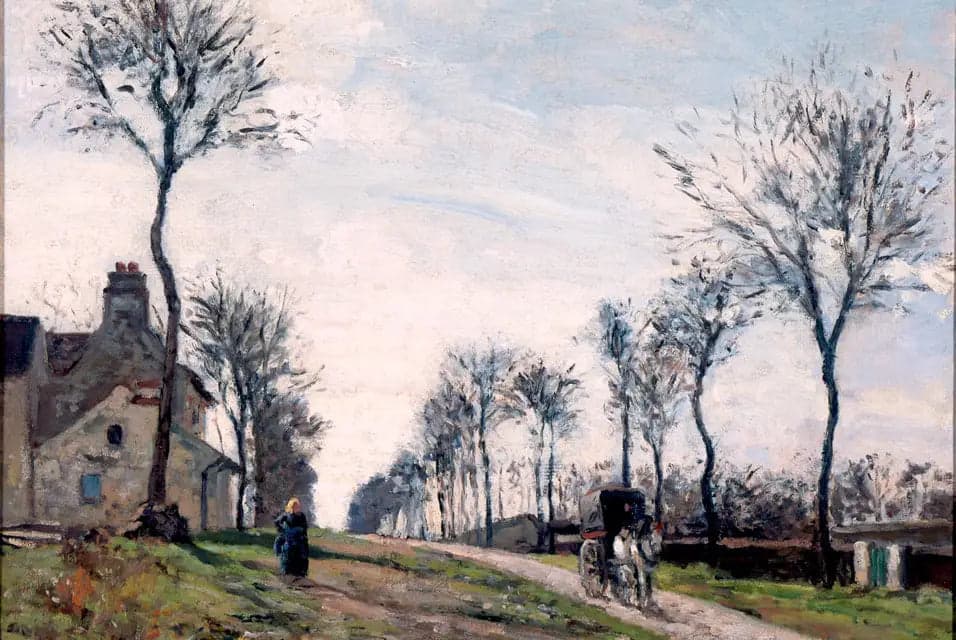
The Road to Marly
- Original dimensions
- 46 x 38.1 cm
- Museum
- High Museum of Art
- Year
- 1870
Scene depicted
This canvas depicts a bucolic scene where lush nature intertwines with the tranquility of the winding roads of Marly-le-Roi. Majestic trees, caressed by the gentle breeze, offer a soothing shade, while shadows and lights dance on the ground. Through this canvas , Pissarro provides a nostalgic evocation, a suspended moment where time seems to stop, allowing the viewer to immerse themselves in the harmony of nature.
Historical context
Created in 1870 in the town of Marly-le-Roi, this painting is part of the Impressionist movement, a time when light and color became the key words of art. In the heart of France, this canvas bears witness to a rich period, at the crossroads of artistic influences and social upheavals. Currently, this work is exhibited at the High Museum of Art , thus linking the past and present. Its remarkable dimensions of 46 x 38.1 cm make it a striking masterpiece .
Place in the artist's career
The Road to Marly represents a pivotal moment in the career of Camille Pissarro , a time when his style matures, integrating Impressionist elements while retaining a naturalistic essence. Alongside other works such as The Apple Harvest and The Boulevard Montmartre, Spring , this painting highlights his technical evolution and passion for changes in light.
Anecdote
“Light is a journey,” said Camille Pissarro , and it is exactly this quest that inspired this canvas . One cool morning, walking along the paths of Marly, his eyes captured the fleeting beauty of the sleeping nature, ready to awaken. Each brushstroke in The Road to Marly resonates with this first spark of inspiration, transforming a fleeting moment into eternity.