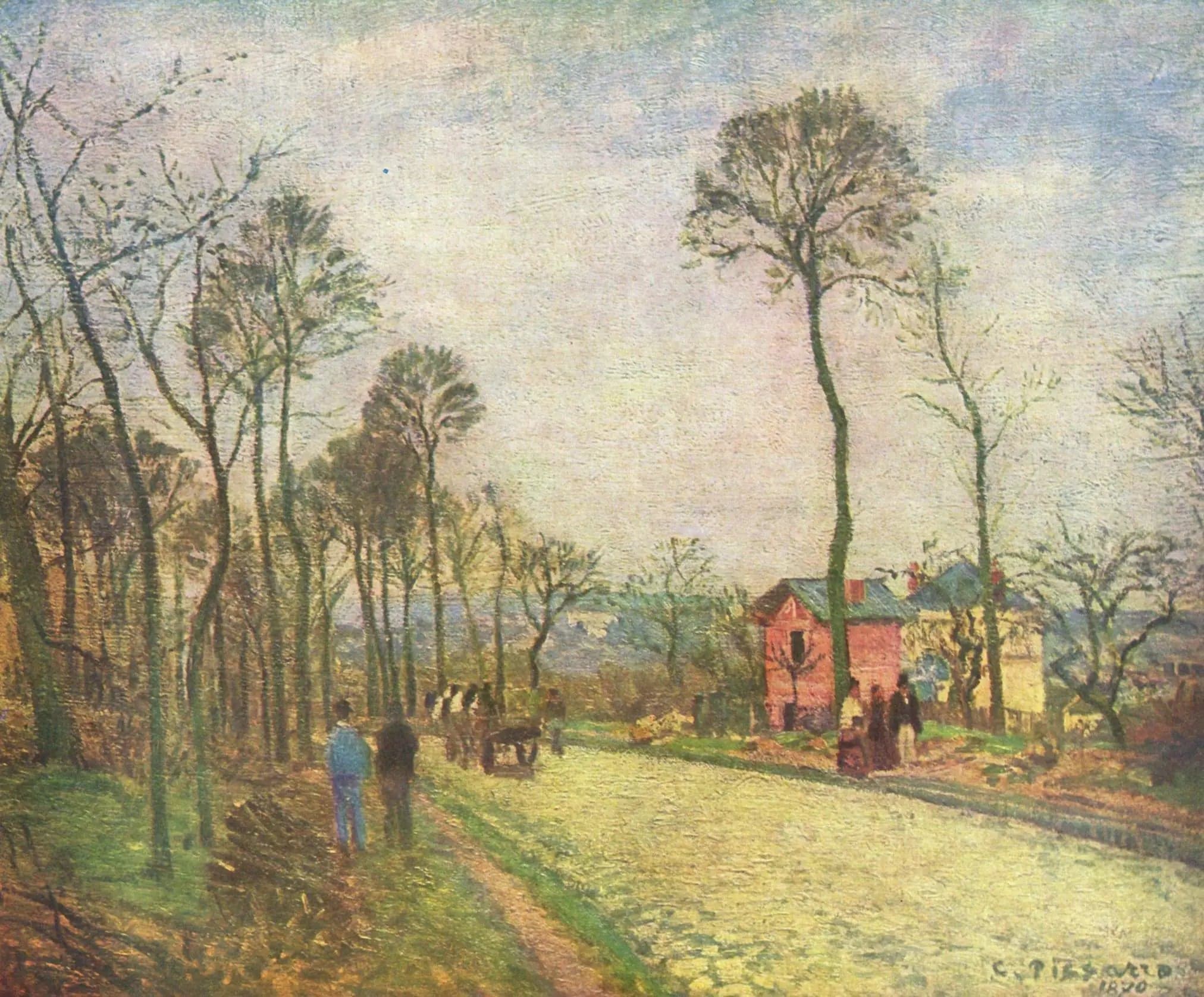
The Road to Louveciennes
- Original dimensions
- 73.5 x 59.8 cm
- Museum
- Orsay Museum
- Year
- 1872
Scene depicted
In this pictorial work, light plays a fundamental role, illuminating the winding path that snakes through a lush landscape. Majestic trees, rising proudly, frame the road while shadows lengthen, telling a story of passage and movement. Pissarro invites us to a silent contemplation, where each brushstroke evokes the sweetness of rural life.
Historical context
Created in 1872, in the heart of the beautiful town of Louveciennes, this iconic painting is situated at the crossroads between impressionism and realism . The Road to Louveciennes reflects an era where nature is sublimated by the afternoon light. Currently, this painting delights visitors at the Orsay Museum , embodying a poetic vision of the world and offering a journey through time with its dimensions of 73.5 x 59.8 cm.
Place in the artist's career
This painting represents a pivotal period in Pissarro's career, marking his rise in the impressionist world. By comparing it to works like The Apple Harvest and The Banks of the Seine , one can observe a stylistic evolution where nature becomes, through the canvas , a true character. This painting testifies to his constant search for light and color, affirming his role as a pioneer.
Anecdote
“Beauty is often found in the simplicity of mundane scenes.” This quote from Camille Pissarro resonates intensely when contemplating his masterpiece . Imagine a bright morning, a calming tranquility enveloping the countryside. At that time, a simple dirt path becomes a source of inspiration, revealing the evocative power of painting that traces the daily lives of the men and women of his era.