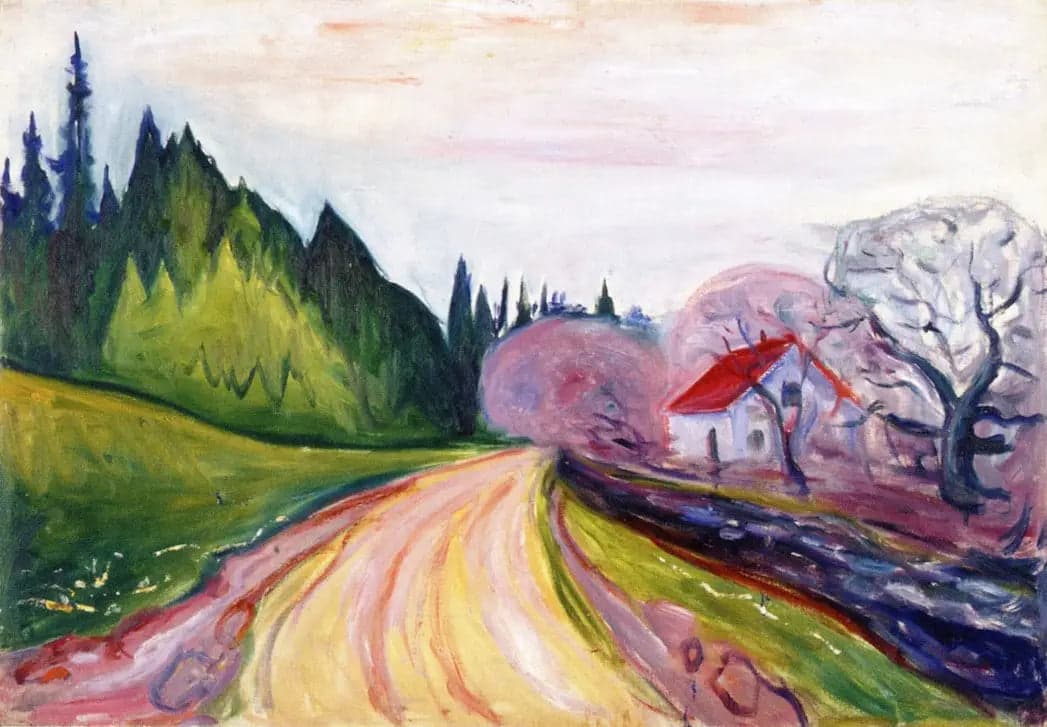
The Road to Borre
- Original dimensions
- 100 x 70 cm
- Museum
- Munch Museum
- Year
- 1905
Scene depicted
This painting illustrates a narrow path, surrounded by lush vegetation, leading to a distant house nestled under a stormy sky. The heavy atmosphere evokes the tug-of-war between majestic nature and human experience, captivating the viewer with its emotional depth. Each element of this canvas interlocks harmoniously, creating a perfect balance for the eye, and resonates with the soul.
Historical context
Created in 1905, the famous painting by Edvard Munch , The Road to Borre , is set against the troubling backdrop of the late 19th and early 20th centuries, a time marked by existential struggles and psychological concerns. This canvas , which resides today at the Munch Museum in Oslo, is fully part of the expressionist movement, revealing the transition towards a deeper exploration of human emotions.
Place in the artist's career
The Road to Borre represents one of the significant milestones in Munch's career. Situated in a period of artistic affirmation, this painting is positioned between masterpieces like The Scream and The Madonna . Through this composition , the artist explores themes of solitude and hope, thus revealing the evolution of his technique and artistic concerns.
Anecdote
Edvard Munch once said: "Painting is a confession of my sufferings and my hopes." It was during a foggy morning by the sea that the artist was inspired by a winding path to Borre, a place steeped in memory. The Road to Borre then evokes the eternal call of nature and the quest for inner liberation, immersing us in this pictorial work full of nuance.