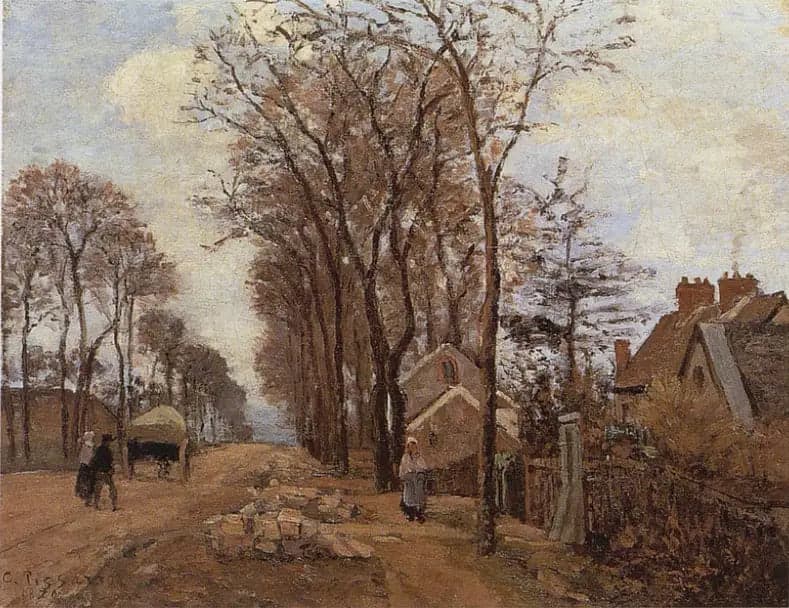
The Road from Saint-Germain to Louveciennes
- Original dimensions
- 46.5 x 38.5 cm
- Museum
- Rolandseck Contemporary Art Museum
- Year
- 1870
Scene depicted
This canvas immerses us in a fleeting moment of daily life, where the tranquility of country roads intertwines with weeping willows and lush fields. Pissarro's brushes capture the light filtering through the foliage, revealing an atmosphere of serenity and wonder. A scooter rider or a solitary walker can be guessed around a bend, making this moment an invitation to inner travel and contemplation.
Historical context
Created in 1870, this painting is an homage to the beauty of the French landscape, more precisely to Louveciennes, a charming commune in the Île-de-France region. The Impressionist movement, of which Camille Pissarro is one of the emblematic figures, bathes this canvas in a unique light, capturing the very essence of nature in full awakening. This work is currently housed at the Rolandseck Contemporary Art Museum and measures 46.5 x 38.5 cm, a size that gives it a striking intimacy.
Place in the artist's career
The Road from Saint-Germain to Louveciennes is a milestone in Pissarro's career. At this time, he explores the nuances of nature and the contemporary effects of industrialization, while remaining true to earlier works like Place du Théâtre Français , and continuing his path towards bolder creations such as The Gardens of Éragny . This masterpiece perfectly illustrates his ability to evolve while remaining in harmony with his artistic movement.
Anecdote
Camille Pissarro stated: "I seek the daylight, life outdoors." That morning, by the side of the road from Saint-Germain, he was undoubtedly inspired by the song of a nearby stream and the fresh scent of wildflowers. The painting is therefore much more than a figurative representation; it emanates from the very soul of nature, from the emotion that only the artist felt in front of this living tableau.