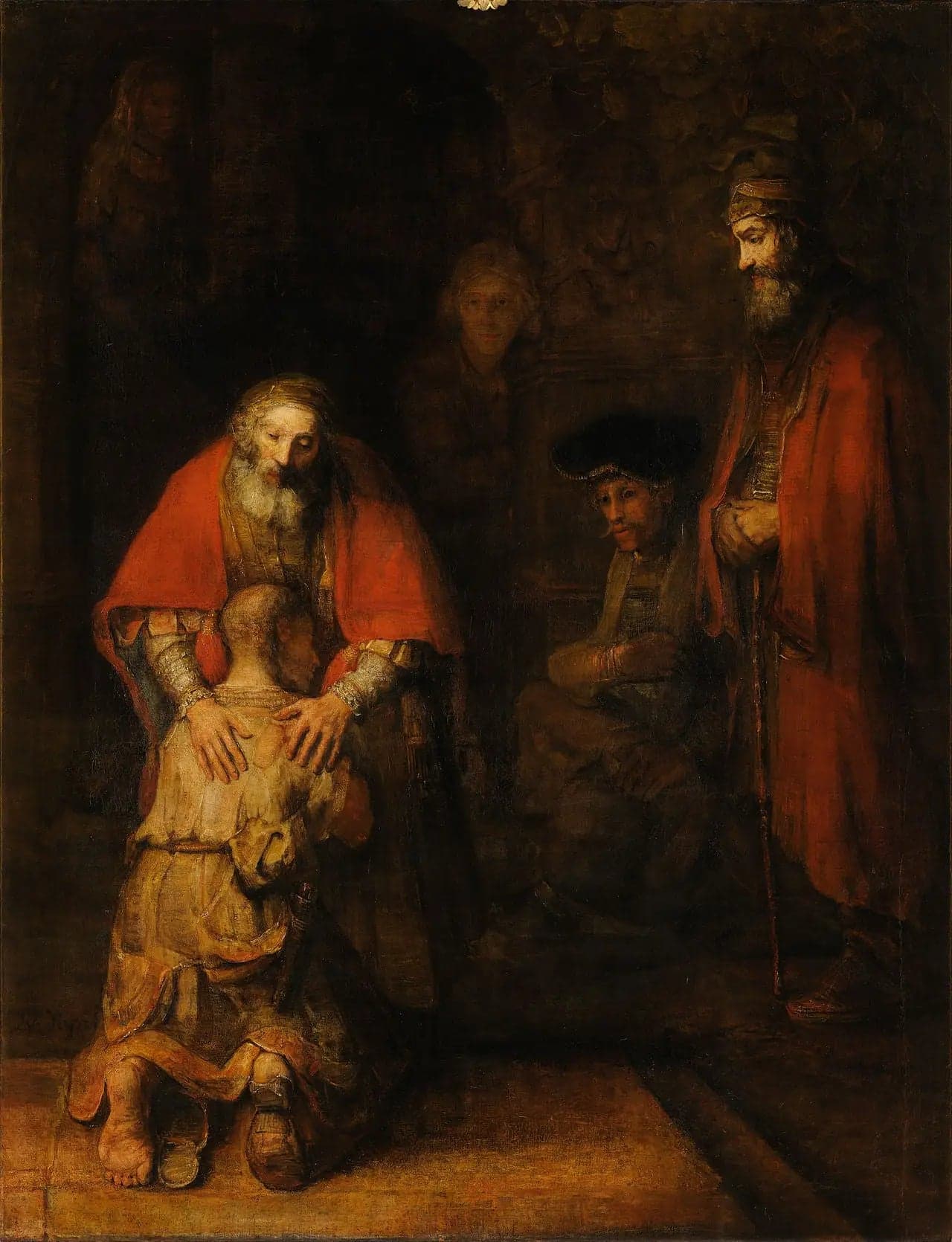
The Return of the Prodigal Son
- Original dimensions
- 205 x 262 cm
- Museum
- Hermitage Museum
- Year
- 1668
Scene depicted
This masterpiece illustrates a striking biblical scene: the return of a lost son to his father, after a life of despair and debauchery. Rembrandt manages to capture, with palpable emotion, the mix of joy, unconditional love, and redemption. At the center of the composition, the human figures are outlined with psychological depth, while the luminous path of gazes circulating on the canvas invites the viewer to feel this moment of grace.
Historical context
Created in the heart of the Dutch Golden Age, the painting emblematic, The Return of the Prodigal Son , testifies to the unparalleled mastery of Rembrandt in pictorial art. In 1668, in Amsterdam, Rembrandt captures the poignant and universal moment of forgiveness and redemption. This canvas , which has become one of the pivots of the artist's work, is today carefully preserved at the Hermitage Museum .
Place in the artist's career
The Return of the Prodigal Son represents the pinnacle of Rembrandt 's ability to marry technique and emotion. In line with works like The Night Watch and The Anatomy Lesson of Dr. Tulp , this painting illustrates his evolution towards a more introspective and subtle approach in his human representations. It is an invitation to deep reflection on the human condition.
Anecdote
It is said that Rembrandt , absorbed by the golden light of a summer morning, paused for a moment before the scene of reconciliation between a father and his son. He would have then murmured: "Light reveals the truth of souls." This inspiration breathes through every brushstroke of his canvas , reinforcing the evocative power of The Return of the Prodigal Son .
Major exhibitions
Hermitage Museum