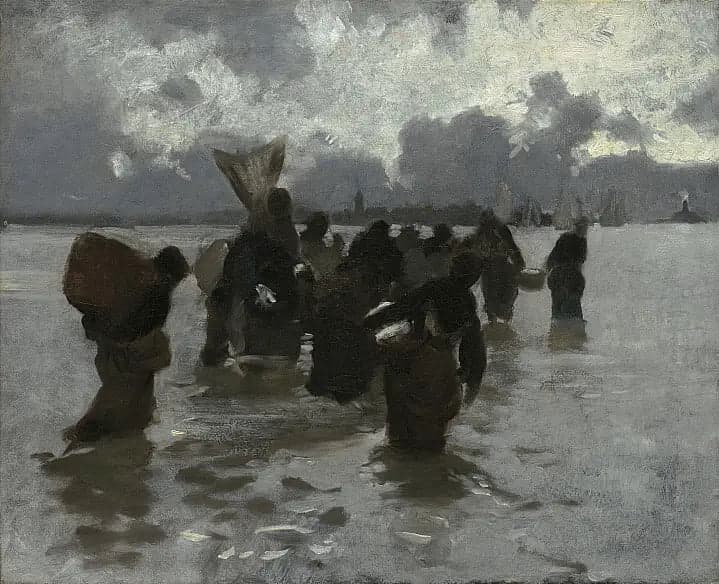
The Return of the Fisherwomen
- Original dimensions
- 61.6 x 49.85 cm
- Museum
- Nelson-Atkins Museum of Art
- Year
- 1877
Scene depicted
The painting depicts the return of the fisherwomen, their silhouettes standing out against a background of calm sea. Their faces express a gentle fatigue, while the atmosphere evokes the tranquility of a day of work well done. The nets are raised, the skies reflect in the peaceful waters; the scene becomes an ode to the daily life of women on the coast.
Historical context
Created in 1877, the iconic painting The Return of the Fisherwomen by John Singer Sargent finds its roots at the heart of the Impressionist movement that was emerging in France. This painting, revealing the delicate lights of the coastline, comes to life in a context where the artist explores the themes of woman and nature, capturing the way these two elements converge. Currently, this canvas is displayed at the Nelson-Atkins Museum of Art , a sanctuary for art enthusiasts, showcasing Sargent's genius through its refined dimensions.
Place in the artist's career
Situated in Sargent's promising early years, The Return of the Fisherwomen appears as a cornerstone revealing his flourishing skill. One can also see a technical evolution in works such as Madame X and The Children in a Garden , which reflect his progress in terms of composition and emotional expression. This painting is a crucial milestone testifying to the awakening of a talent synonymous with modernity.
Anecdote
Sargent, while painting The Return of the Fisherwomen , stated: "Every brushstroke is a dance that captures the moment." Inspired by a misty morning on the coast, he becomes enchanted by the fluid shapes of the fishermen and the harmony of colors. This fleeting moment, captured on the canvas , reveals an evocative force that emerges from this work of peace.