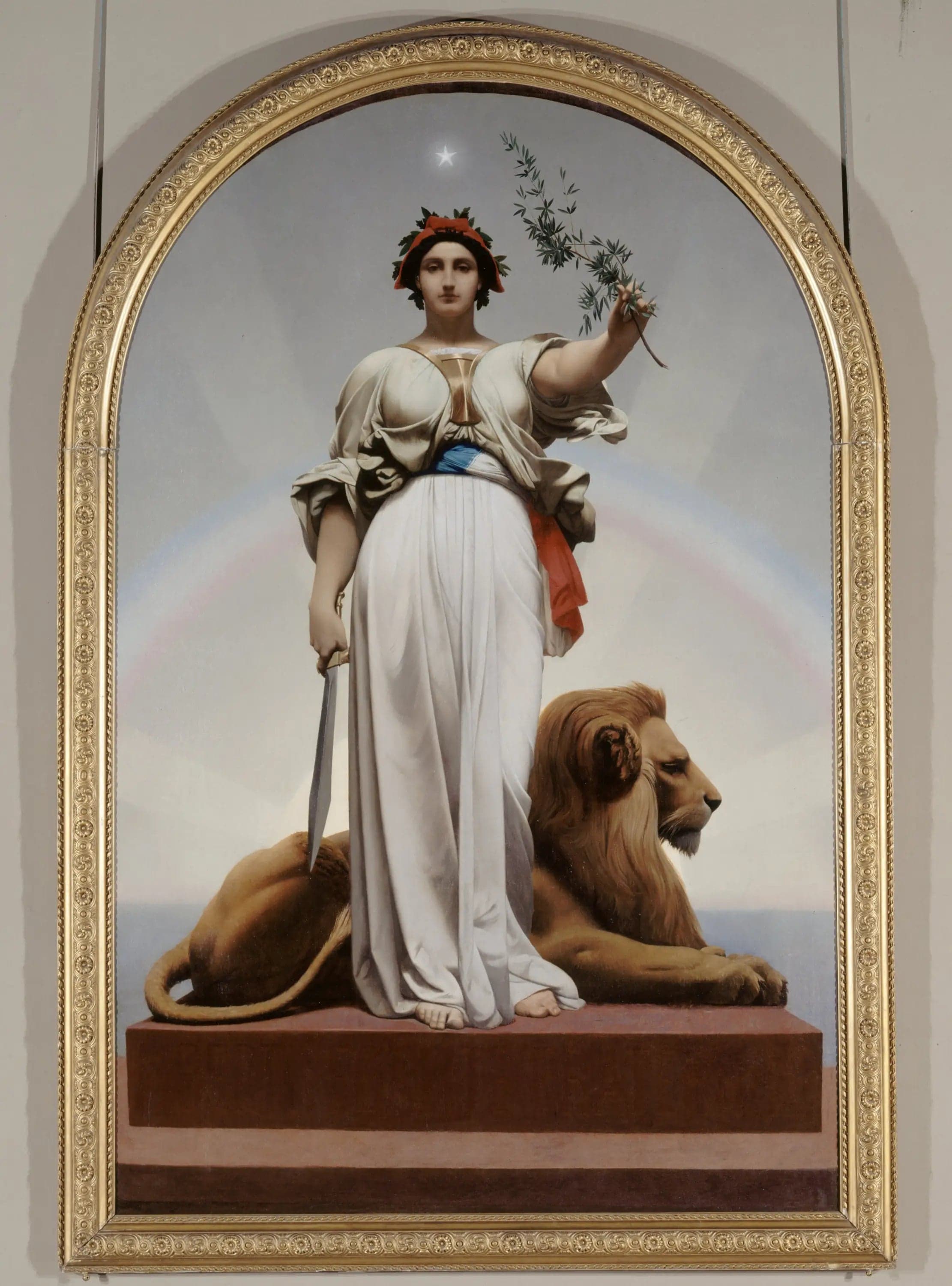
The Republic - Jean
- Original dimensions
- 223 x 322 cm
- Museum
- Petit Palais
- Year
- 1848
Scene depicted
This painting, an ode to freedom, represents an allegory of the Republic surrounded by symbolic figures that embody justice and wisdom. The dynamism of the postures, the richness of the costumes, and the harmony of colors immerse us in a historical moment caught between a glorious past and a promising future, capturing the essence of a time of change and hope.
Historical context
The painting titled The Republic was created in 1848, at the heart of the French Revolution, precisely in the city of Paris, then the epicenter of republican ideals. This emblematic work is part of the neoclassical movement, a perfect blend of graphic rigor and emotion. Today, this canvas resides at the Petit Palais , the fine arts museum of the city of Paris, where it continues to inspire generations of visitors. Its imposing dimensions, 223 x 322 cm, capture the very essence of its subject with a rare intensity.
Place in the artist's career
The Republic stands as a major milestone in Gérôme's career, marking a period of maturity. After promising beginnings with works such as Pollice verso and The Gladiators , he refines his style here, demonstrating a mastery that positions him among the greatest painters of his time. This painting, alongside other creations like The Taking of Granada , illustrates an evolution towards more complex compositions and more nuanced emotions.
Anecdote
“Every brushstroke is an echo of the soul of my country,” said Gérôme. It was on a May morning, as the Parisian streets buzzed with songs of freedom, that the artist drew his inspiration for this masterpiece . The delicate light filtered through the branches of linden trees, the smell of recently washed cobblestones, all contributed to bringing this painting to life, which aims to celebrate an unwavering republican spirit.