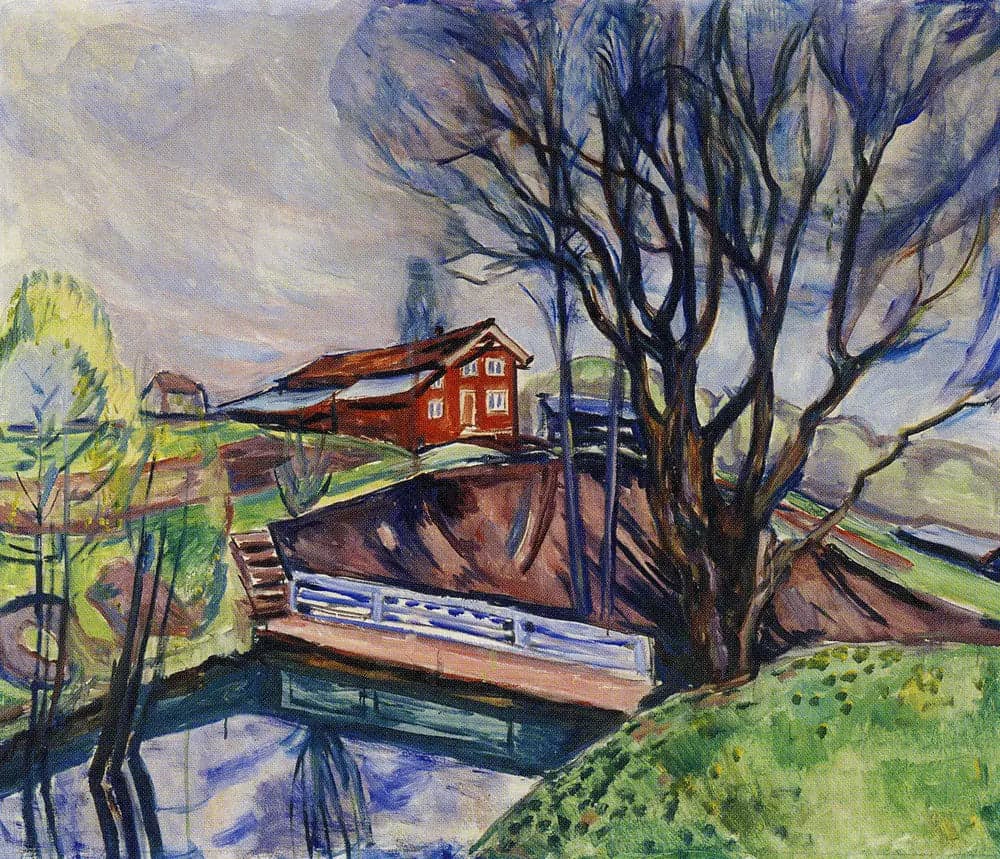
The Red House
- Original dimensions
- 90 x 68 cm
- Museum
- Munch Museum
- Year
- 1926
Scene depicted
The Red House depicts a scene imbued with serenity, where a house, of a fiery red, stands majestically amidst a lush landscape. Through this vibrant composition, Munch evokes a sense of nostalgia and belonging. This intimacy evokes buried memories, as if each stroke of paint captures a piece of the soul. The viewer's eyes are drawn not only by the beauty of the structure but also by the deep emotions it evokes.
Historical context
Created in 1926, The Red House finds its roots in the intimacy of Norwegian landscapes, more precisely in the city of Oslo. This canvas is emblematic of the expressionist movement that marked the work of Edvard Munch . An atmosphere tinged with nostalgia and depth emanates from it, anchored in the cultural context of the time that saw the breath of modernity infiltrate minds. Currently, this pictorial work is carefully preserved at the Munch Museum, where it contributes to the celebration of its creator's legacy.
Place in the artist's career
The Red House is situated at a crucial moment in Edvard Munch 's career, illustrating both his artistic maturity and his ongoing exploration of themes of the human heart. In parallel with works such as The Scream and The Madonna, one can observe an evolution both technical and emotional that composes his unique vision of the world.
Anecdote
“It is in the light of a gentle morning that I discovered the soul of the house, giving it a vibrant appearance.” These words of Edvard Munch resonate so perfectly with The Red House. Imagine a spring morning, enveloped by the gentle whisper of trees and the distant song of birds. This painting is the result of that precious moment when the everyday becomes a scene of eternal beauty.
Major exhibitions
Munch og Ekely: 1916-1944