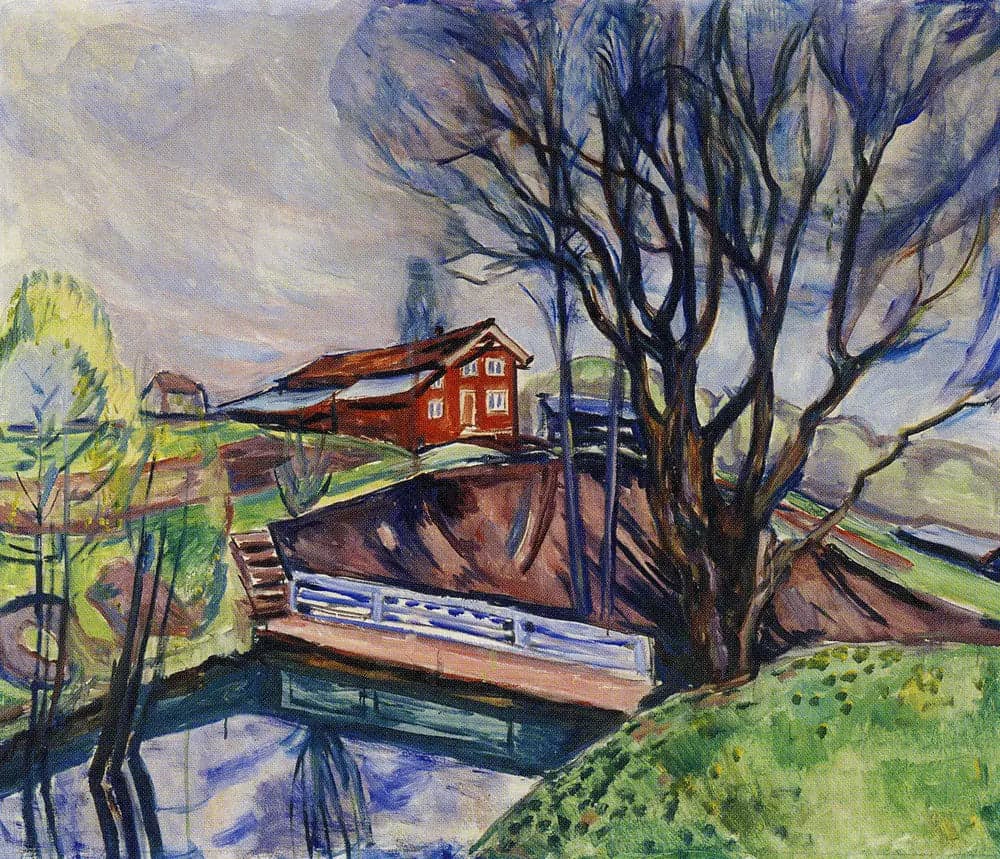
The Red House
- Original dimensions
- 100 x 79.5 cm
- Museum
- Not specified
- Year
- 1926
Scene depicted
The Red House is a canvas that depicts a dwelling, in the shadow of a troubled sky. The bright red structure, sharp among the surrounding greenery, evokes a sense of refuge, while the surrounding nature seems to insistently encircle this home. This painting conjures solitude and melancholy, interpreting the complexities of being human through the prism of architecture and its environment.
Historical context
Created in 1926, this painting emblematic finds its origin in Norway, within an artistic context marked by expressionism . Edvard Munch , a central figure of this movement, captures here the essence of an era where emotions and personal experiences took center stage. The announcement of the social and psychological upheavals of his time resonates in every brushstroke. Currently, this canvas is not attached to any specific museum, but its notoriety makes it a living symbol of 20th-century art.
Place in the artist's career
The Red House fits into an advanced chapter of Munch's career, demonstrating a pronounced stylistic mastery. It stands alongside other significant canvases , such as The Scream and The Madonna, where the artist systematically explores themes of human suffering and existential anguish.
Anecdote
“A painting must infuse the soul of the moment,” said Munch, recalling a morning under the Norwegian sky, enveloped in mist and the scent of damp earth. It is in the heart of this poetic atmosphere that he found inspiration for his canvas , making The Red House a reflector of the deepest human emotions.