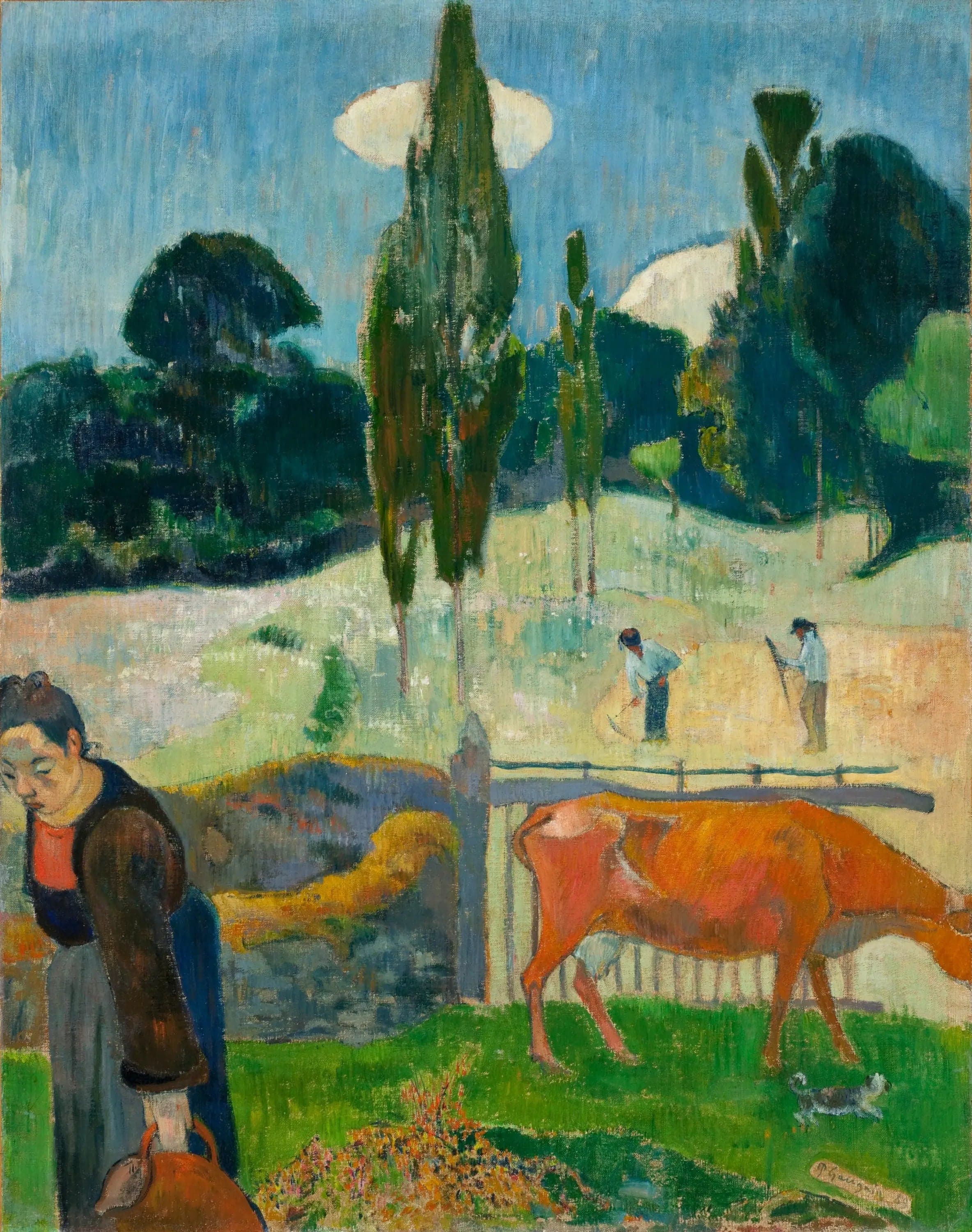
The Red Cow
- Original dimensions
- 73 x 90.8 cm
- Museum
- Los Angeles County Museum of Art
- Year
- 1889
Scene depicted
In The Red Cow , Gauguin captures a simple yet evocative scene: a peaceful cow, still against a backdrop of lush foliage, at times familiar, at times enigmatic. The choice of a vibrant and stripped-down palette suggests not only the beauty of nature but also the depth of feelings it evokes in the viewer, offering a face-to-face contemplation between man and animal.
Historical context
Created in 1889 in Pont-Aven, Brittany, The Red Cow is emblematic of the post-impressionist movement. In a context where art is freeing itself from its conventions, Paul Gauguin invites us to explore a colorful and symbolic vision of nature. Currently exhibited at the Los Angeles County Museum of Art , this painting measures 73 x 90.8 cm and demonstrates the brilliance of an era where emotion and intuition took precedence over technical precision.
Place in the artist's career
The Red Cow is situated at a significant turning point in Gauguin's career. This painting illustrates the transition from an impressionist style to a bolder exploration of forms and colors, alongside works such as Vision After the Sermon and The Yellow Christ . In doing so, it testifies to the evolution of his artistic approach towards greater abstraction and increased emotional intensity.
Anecdote
“Color is my language. It expresses what words cannot say,” Gauguin is said to have declared. One spring morning, while walking in the Breton countryside, he was struck by the raw beauty of a cow with a fiery coat. This fleeting moment led him to create this masterpiece , revealing the vibrant soul of the land through painting .