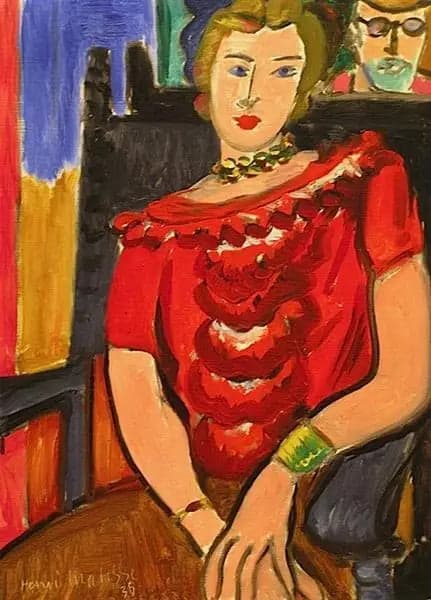
The Red Blouse
- Original dimensions
- 33.3 x 46.7 cm
- Museum
- McNay Art Museum
- Year
- 1936
Scene depicted
This painting is a lively celebration of a simple woman wearing a bright red blouse, surrounded by a universe of flamboyant colors. The composition presents the subject in a way that highlights her grace while creating fascinating dialogues between shadows and lights. In this masterpiece , Matisse does not simply seek to represent reality but to transcend it, inviting the viewer to feel the vibration of each color, each stroke.
Historical context
Created in 1936, during a flourishing period in the city of San Antonio, Texas, The Red Blouse is part of the Fauvist artistic movement, famous for its liberation of cheerful colors and simple forms. At that time, the movement was spreading beyond French borders, illuminating the eyes of those discovering the emotional power of colors. This canvas , currently exhibited at the McNay Art Museum , remains a vibrant testimony to a time of artistic transition. The dimensions of the painting emphasize its visual impact, capturing the eye with its boldness and depth.
Place in the artist's career
The Red Blouse marks a key milestone in Matisse's career, reflecting his stylistic evolution towards an increasingly bold abstraction. Compared to The Dance and The Joy of Life , these works share a similar chromatic intensity but reveal a gradual widening of forms and a simplification of lines. This pictorial work demonstrates the pinnacle of his exploration of color as an artistic language.
Anecdote
Henri Matisse , known for his sensitivity to forms and tones, once declared: “Color is the starting point of my art; it is what must guide the heart and mind.” The inspiration for this masterpiece came to him during a stroll through the sunny streets of Paris, one spring morning when the scent of flowers floated in the air, intertwining with the melody of conversations veiled by the soft noise of the city. This painting evokes those fragile moments, an emotion brilliantly captured.