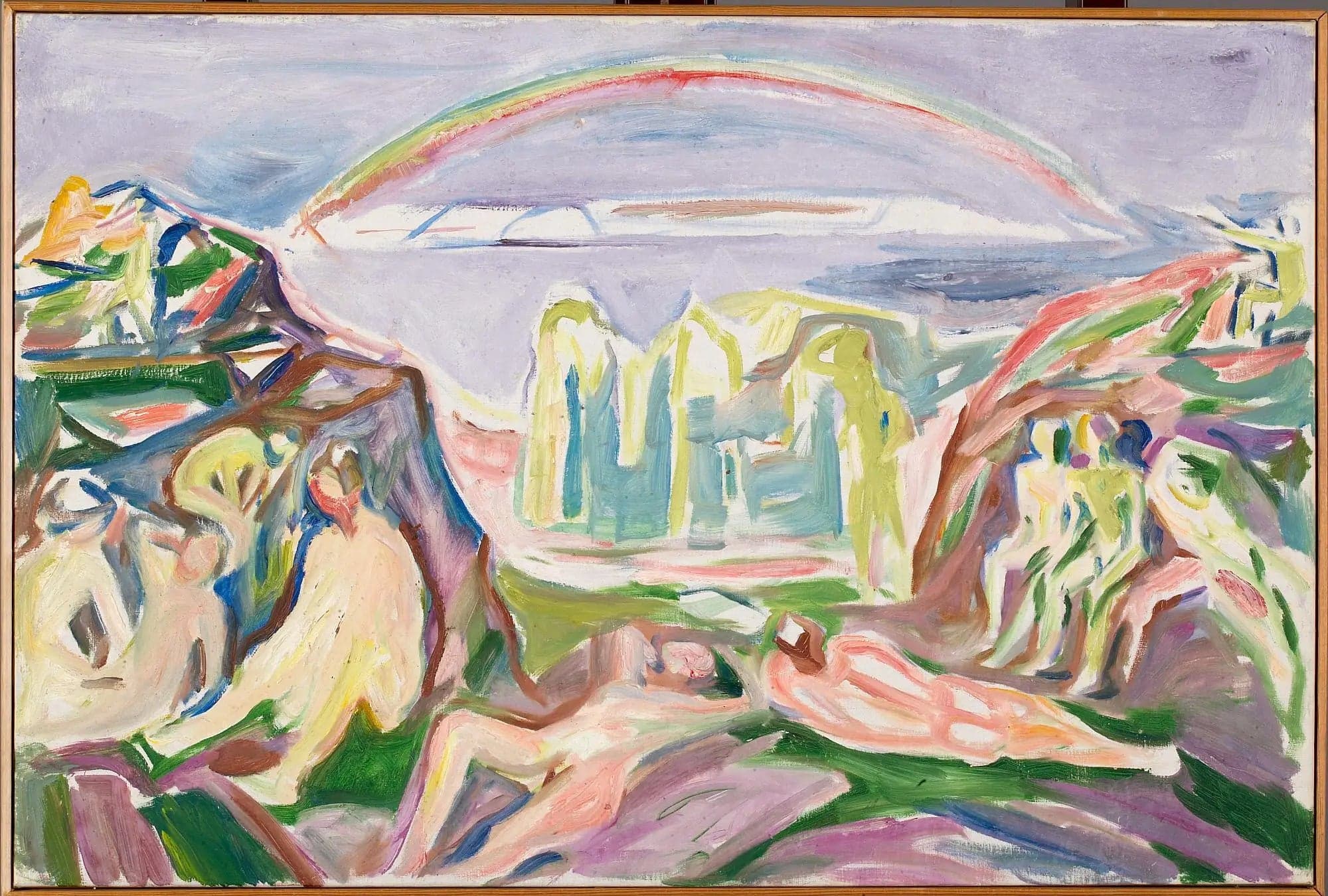
The Rainbow
- Original dimensions
- 219 x 111.5 cm
- Museum
- Munch Museum
- Year
- 1924
Scene depicted
This painting fascinatingly recreates the ephemeral natural phenomenon of a bright rainbow, like a bridge between sky and earth. The vibrant colors of this masterpiece are more than a mere representation; they embody emotions, dreams, and renewed hope, a symbol of transcendence and harmony.
Historical context
Created in Oslo, Norway, in 1924, The Rainbow is an iconic work of the expressionist movement. This canvas that summarizes the nuances of human emotions is now preserved at the Munch Museum, where it charms every visitor with its vibrant history and imposing dimensions.
Place in the artist's career
The Rainbow fits into a pivotal moment in Munch's career, oscillating between feelings of abandonment and hope. Alongside works such as The Scream and Madonna , this painting illustrates his technical mastery and emotional universe, revealing the depth of his artistic expression.
Anecdote
“Art must be a resonance of life” Munch might have said, although this quote is a guessed inspiration. Imagine the artist, on a bright morning, absorbing the raw light that bathes the Norwegian landscape, fervently capturing the spectral arc that ignites his gaze. It is in this communion with nature that the evocative power of The Rainbow awakened.