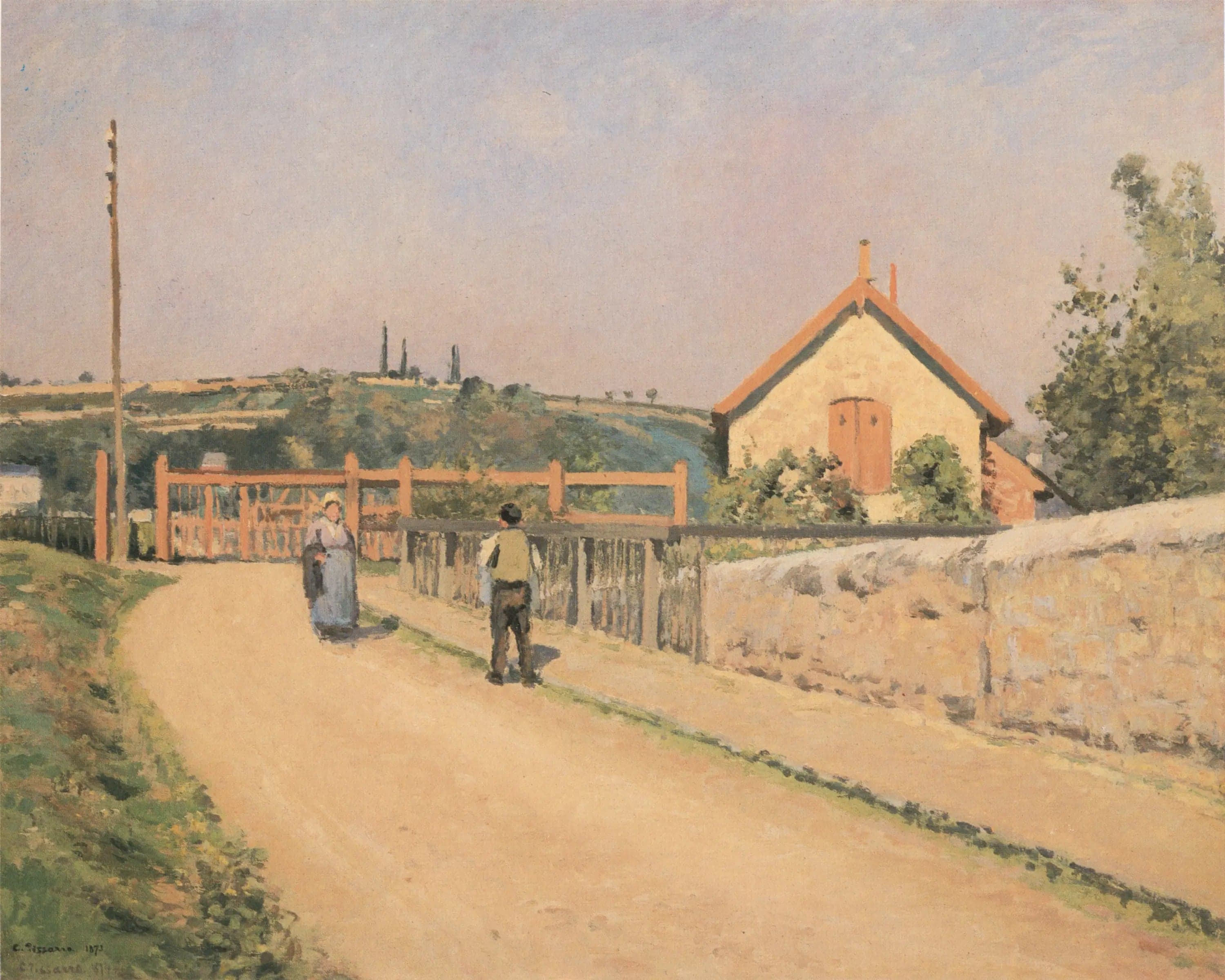
The Railway Barrier at Pâtis, near Pontoise
- Original dimensions
- 81 x 65 cm
- Museum
- Not specified
- Year
- 1873
Scene depicted
In this painting , Pissarro invites us to contemplate a frozen moment where the tranquility of the pastoral landscape mingles with the nascent industrialization through the presence of the railway. This painting captures the delicate balance between the flourishing nature and the emergence of a new era, radiating a golden light that gives the whole a serene atmosphere.
Historical context
Created in 1873, this canvas emblematic of Camille Pissarro comes to life in the charming region of Pontoise, the cradle of the Impressionist movement. At that time, the city became a true crossroads of artists seeking to capture the light and the Norman landscapes. The work is not currently exhibited in a specific museum , but its imprint on the history of art remains indelible.
Place in the artist's career
“The Railway Barrier at Pâtis” stands as a keystone in Pissarro's career. It is during this period of artistic maturity that he develops his unique style. Alongside the canvas "The Artist's Garden at Éragny" and "The Road to Lunéville", one observes a fascinating evolution in his technique, favoring a bolder approach to the use of light and a vibrant color palette.
Anecdote
“Nature, with its wonders, never ceases to evoke in me the desire to paint,” Pissarro is said to have remarked one spring morning. It is in this soothing setting, on a railway in a peaceful countryside, that the idea for this masterpiece germinates, combining the harmony of landscapes and the presence of man in his environment.