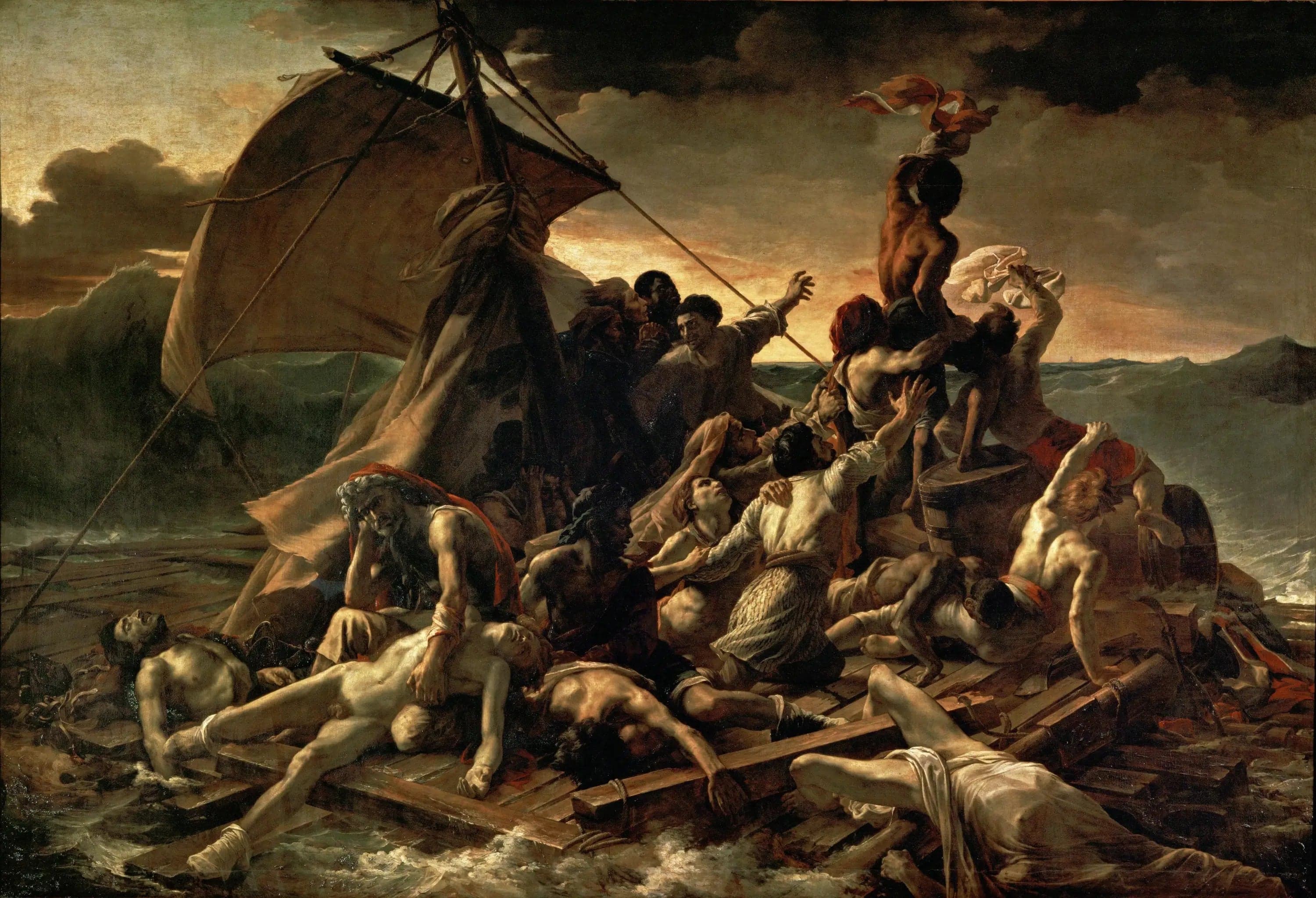
The Raft of the Medusa
- Original dimensions
- 716 x 491 cm
- Movement
- romanticism
- Museum
- room 700
- Year
- 1819
Scene depicted
The painting "The Raft of the Medusa" depicts the suffering of the shipwrecked, lost at sea on a makeshift raft, struggling for survival against the rising waves. The work reveals human drama in all its cruelty, paying tribute to a tragedy that has marked the collective consciousness. This painting does not merely represent an event; it invites deep reflection on the fragility of life.
Historical context
Artwork: The Raft of the Medusa |BRK| Artist: Théodore Géricault |BRK| Year: 1819 |BRK| Museum: room 700 |BRK| Dimensions: 716 x 491 cm |BRK| Artistic Movement: romanticism |BRK| Major Exhibitions: Salon of 1819 |BRK|
Place in the artist's career
"The Raft of the Medusa" represents a pinnacle in Géricault's career, combining his passion for romanticism with precise technique. Alongside his previous work "The Race of Free Horses" and "The Disaster of the Medusa," this painting marks a true evolution both technically and emotionally.
Anecdote
Théodore Géricault reportedly stated: "To capture the essence of humanity, one must dive into its despair and hope." This thought was the seed of his inspiration as he observed the portraits of the shipwreck survivors. One afternoon, illuminated by soft light, he perceived the weight of despair embodied in their gaze, and this subtle painting was born from their struggle.
Major exhibitions
Salon of 1819