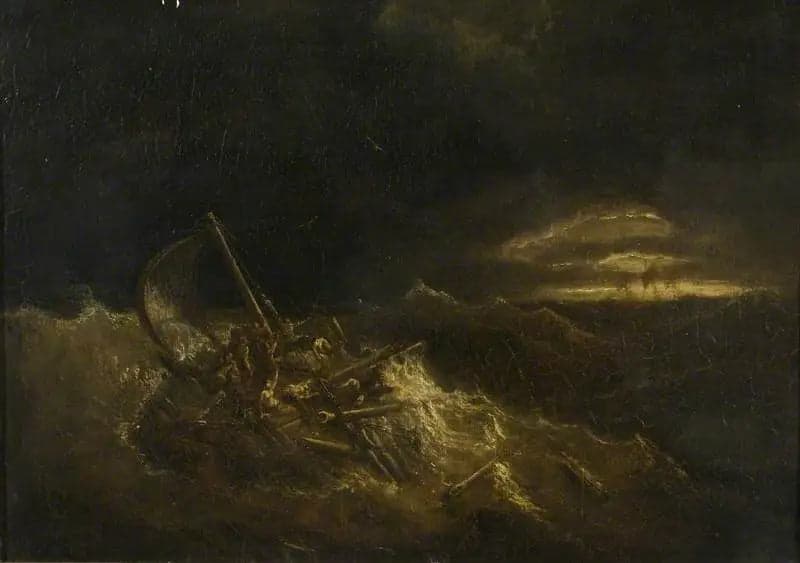
The Raft
- Original dimensions
- 59 x 41 cm
- Museum
- Northampton Museum and Art Gallery
- Year
- 1807
Scene depicted
In this iconic painting, Turner illuminates a tragic scene: shipwrecked individuals gathered on a floating debris struggle for survival. The desperate expression of these lost souls, contended by the raging sea, is an invitation to contemplation and deep empathy. The tourmaline hues of the stormy skies contrast with the tragic outcome, a moment suspended between life and death.
Historical context
Created in 1807, "The Raft" is part of the Romantic movement, a time when emotion and nature took precedence over the rationalism of the Enlightenment. Turner, while living in London, draws inspiration from the tragic tales of shipwrecks to give a visual voice to human turmoil. This painting , now displayed at the Northampton Museum and Art Gallery, with its dimensions of 59 x 41 cm, evokes a deep cry of despair in the face of the human condition.
Place in the artist's career
"The Raft" marks a turning point in Turner's career, signaling the beginning of a fruitful creative period. In parallel, "The Last Voyage" and "The Breakwater" highlight this stylistic evolution, where the master breaks free from norms to experiment with light and color, thus forging an artistic language that is uniquely his own.
Anecdote
"Art is a light in the darkness," Turner might have said, as he painted this masterpiece one spring morning, capturing the melancholy of a scene devastated by waves. His inspiration came from reading accounts of the famous shipwreck of the Méduse, an emotional work where each brushstroke resonates like an echo of human suffering.