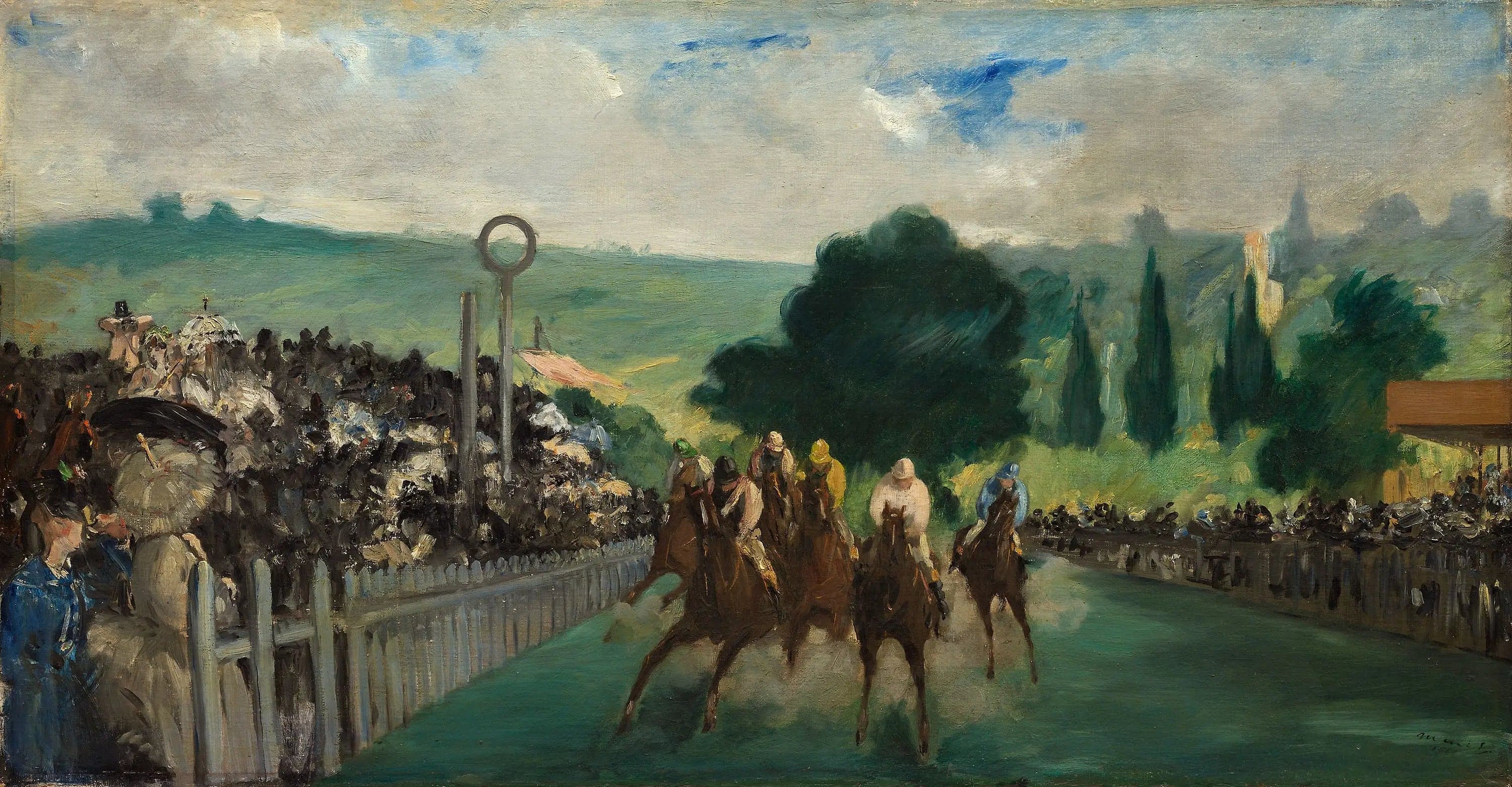
The Races at Longchamp
- Original dimensions
- 84 x 44 cm
- Museum
- Art Institute of Chicago
- Year
- 1866
Scene depicted
The canvas “The Races at Longchamp” illustrates a typical scene of the Parisian aristocracy, captivated by the frenzy of horse racing. The spectators, in elegant attire, compete in expression and attitude, creating a lively choreography at the heart of this competition. The light plays with the shimmering clothing, while the horses gallop, embodying both the beauty and the stakes of society at the time.
Historical context
Created in 1866, the painting “The Races at Longchamp” is a vibrant testimony to the social and artistic dynamics of post-Haussmannian Paris. Set in the heart of horse racing, this pictorial work is part of the emerging Impressionist movement, a movement that dares to capture the ephemeral and the everyday. Currently, the canvas is displayed at the Art Institute of Chicago , where its presence fascinates visitors with its breadth and depth.
Place in the artist's career
“The Races at Longchamp” will place Manet at the forefront of the artistic scene, marking a turning point in his career. This painting is part of a series of works, including “Olympia” and “The Luncheon on the Grass,” where he challenges conventions. Together, they trace a narrative arc of his evolution, moving from raw realism to a looser and freer exploration of forms and lights.
Anecdote
It is said that Édouard Manet used to sit at a café on a spring morning, watching the runners parade under the golden light, thus inspiring the creation of his masterpiece . In a burst of energy, he declared: “Every moment on this canvas is a race, a breath.” This moment of intense effervescence is palpable in the painting , making the experience almost alive.