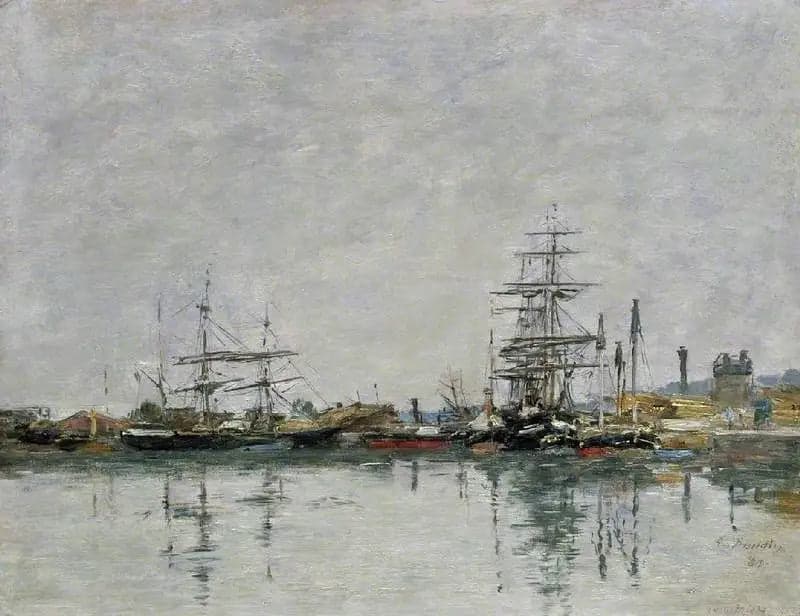
The Quay of Le Havre
- Original dimensions
- 41 x 32 cm
- Museum
- Fitzwilliam Museum
- Year
- 1887
Scene depicted
In this pictorial work , Boudin immerses us in a vibrant scene of the port of Le Havre. The sailboats, illuminated by the light of the setting sun, seem to float peacefully on the calm waters, while human silhouettes bustle on the dock. This painting celebrates the fleeting beauty of port life, an invitation to explore the everyday and the simplicity of moments.
Historical context
Created in 1887, this painting is set in the picturesque backdrop of Le Havre, a dynamic port city in Normandy. The Impressionist movement, of which Eugène Boudin was a pioneer, is reflected in every brushstroke of this canvas , capturing the essence of light and ephemeral atmospheres that characterize the seaside of that era. Today, this precious painting is housed at the Fitzwilliam Museum , where it continues to amaze visitors with its delicate dimensions of 41 x 32 cm.
Place in the artist's career
The Dock of Le Havre represents a significant milestone in Boudin's career. Alongside other works such as The Beaches of Trouville and The Disembarkation of the Regiment in 1880 , this painting marks a turning point, reflecting his evolution towards increasingly bold and luminous compositions.
Anecdote
“I have never sought to impose a vision, but to capture the very moment when light dances on the water.” These words of Eugène Boudin capture the essence of his inspiration, often found during his morning walks along the docks of Le Havre. The evocative power of The Dock of Le Havre emanates from such sensitivity to the fleeting moment.