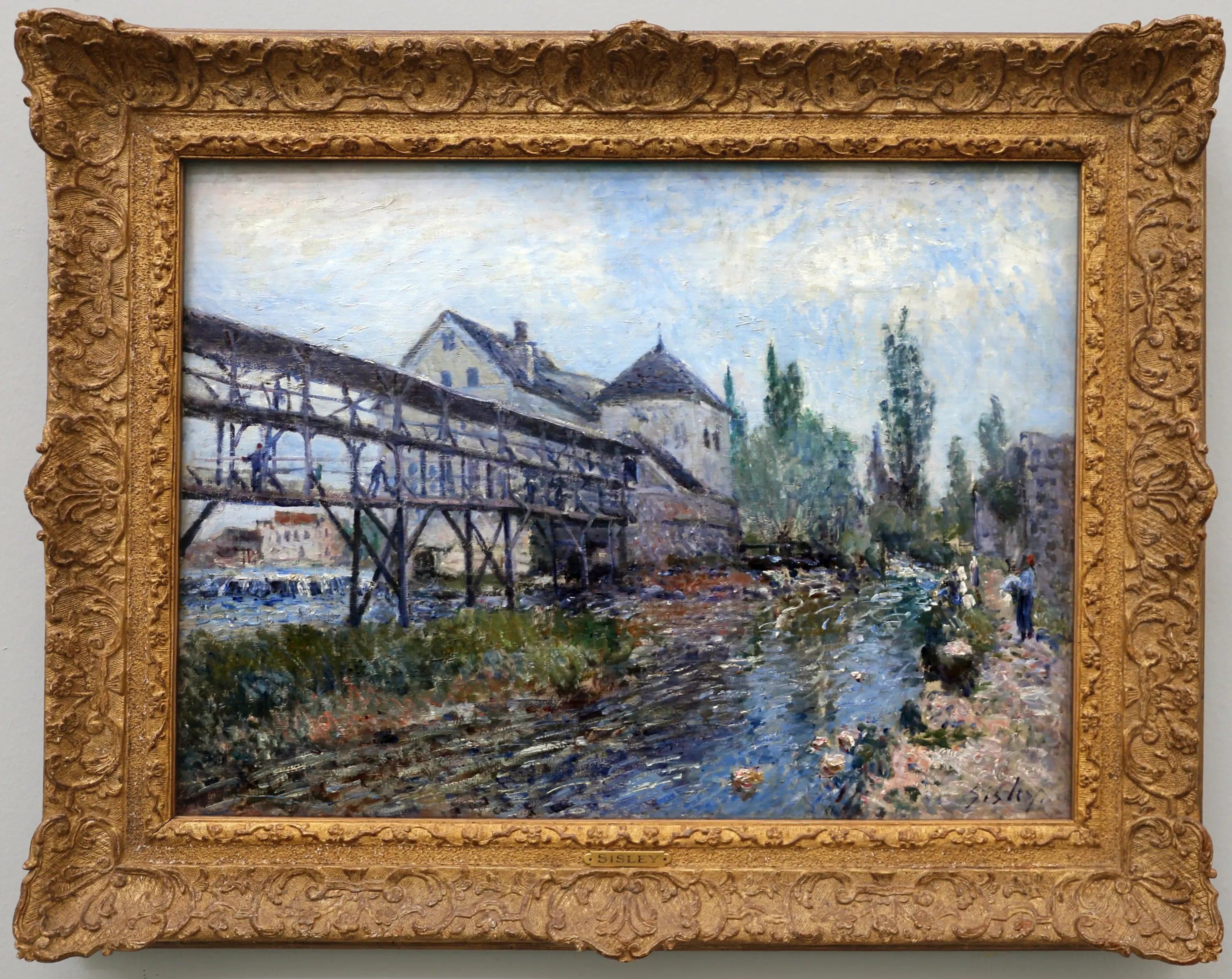
The Provencher Mill in Moret
- Original dimensions
- 73 x 54 cm
- Museum
- Boijmans Van Beuningen Museum
- Year
- 1883
Scene depicted
The Provencher Mill at Moret takes us into a bucolic landscape, illuminated by a golden light sent by the afternoon sun. The mill, the central figure of the composition, stands majestically among the foliage, while the Loing gently murmurs at its feet. The lush green hues of the trees, the sparkling reflections of the water, and the changing skies illustrate the ephemeral beauty of the moment, inviting the viewer to dive into an atmosphere of serenity and tranquility.
Historical context
Created in 1883 in Moret-sur-Loing, a charming commune in the Île-de-France region, the painting The Provencher Mill at Moret is an iconic illustration of the Impressionist movement. Sisley, true to his technique at the end of the 19th century, captured the essence of daily life and the beauty of natural landscapes. This canvas currently resides at the Boijmans Van Beuningen Museum , where it is displayed to the public, becoming a meeting point between the past and the present.
Place in the artist's career
The Provencher Mill at Moret is situated at a crucial turning point in the career of Alfred Sisley , then in full maturity. This canvas represents a marked stylistic advancement, where the artist explores light and shadows even more deeply. In parallel with works like The Seine at Lavacourt and The Beach at Villerville, this painting testifies to his technical evolution and his commitment to capturing the beauty of the ever-changing natural world.
Anecdote
“The light must dance in all my canvases,” Sisley is said to have remarked, depicting what captivated him so much on a gentle spring morning in Moret. This moment of grace, where nature reveals itself, infused vibrant life into The Provencher Mill at Moret. Observing the mill reflected in the calm waters, the artist captured a fleeting poetry, transforming his inspiration into a masterpiece forever etched on his canvas.