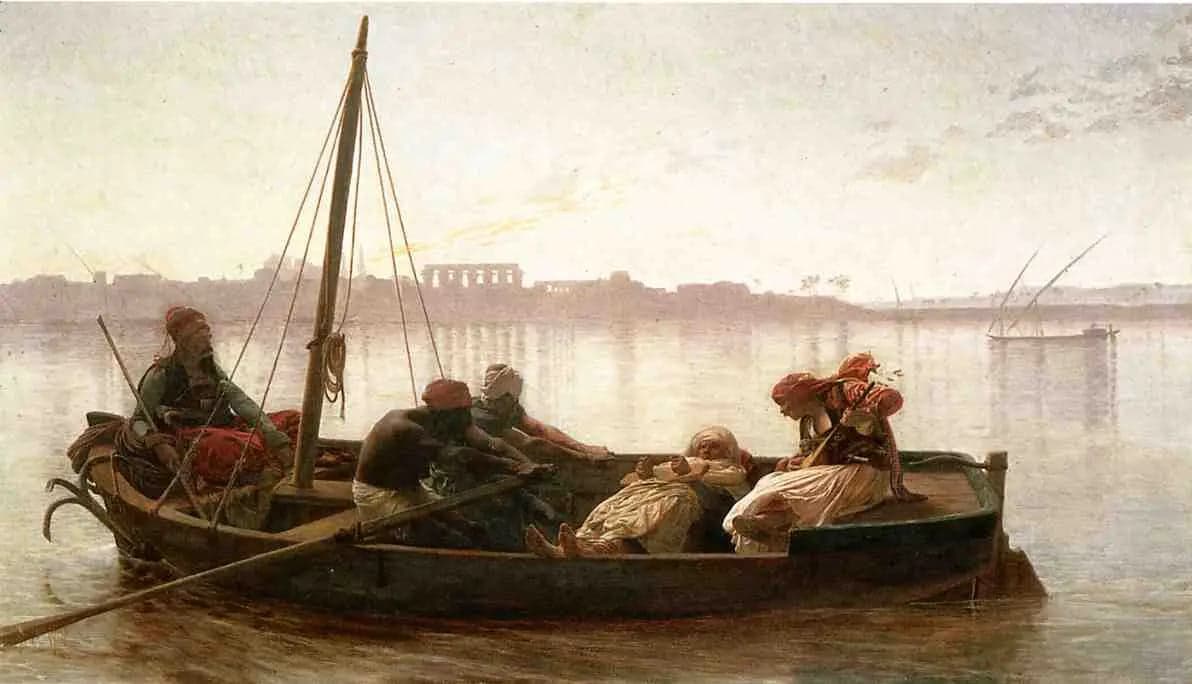
The Prisoner - Jean
- Original dimensions
- 45 x 78 cm
- Movement
- Orientalism
- Museum
- Museum of Arts of Nantes
- Year
- 1861
Scene depicted
In this pictorial work , Jean-Léon Gérôme depicts a chained man, his deep and expressive gaze capturing the viewer's attention. This painting raises themes of captivity and suffering under a sky vibrant with colors, contrasting the purity of art with the harshness of the human condition. The scene is enriched by the meticulous details of the costume and chains, making this moment both tragic and poignant.
Historical context
Created in 1861, this painting is set in the context of the Orientalist movement that captivated European artists in the 19th century, drawing inspiration from the landscapes, cultures, and exotic settings of the Levant countries. The painting is currently displayed at the Museum of Arts of Nantes , thus attesting to its historical and artistic significance. Its dimensions of 45 x 78 cm highlight its visual impact while remaining in a format that allows it to be easily integrated into various interior spaces.
Place in the artist's career
The Prisoner stands as a milestone in Gérôme's career, illustrating his talent for exploring Eastern subjects, which embraces a period of maturity in his journey. When compared to his other iconic paintings such as The Dance of the Almeh and Pollice verso , one can observe a stylistic evolution where emotion and realism take precedence over mere representation.
Anecdote
"Each painting is a fragment of the soul, giving it life is a sacred act." This quote from Gérôme evokes the passion that drove him at the moment of creating The Prisoner . Imagine a sunny morning, where the artist strolls through the narrow streets of an Eastern city, encountering faces imbued with rich stories, thus nourishing his inspiration that is brilliantly transposed onto the canvas.
Major exhibitions
Salon of 1863