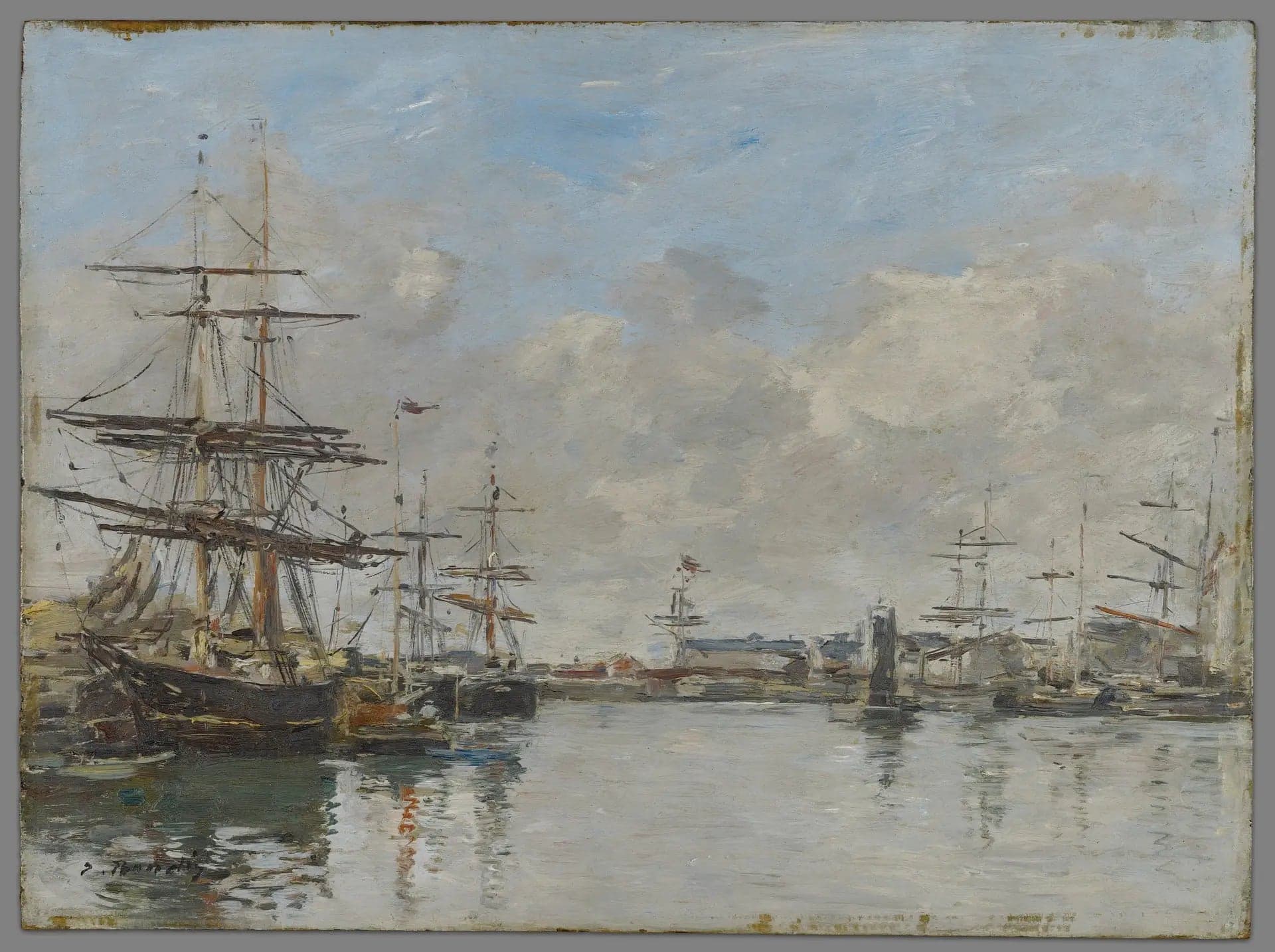
The Port of Le Havre
- Original dimensions
- 35.2 x 26 cm
- Museum
- Yale University Art Gallery
- Year
- 1887
Scene depicted
The painting “The Port of Le Havre” depicts a bustling activity minute by minute, sketching a port animated by the sails of ships and the silhouettes of fishermen. Natural hues blend to shape this canvas vibrant with life, a tactile homage to the changing nuances of the maritime atmosphere. Each element, from the white sails to the colorful boats, tells its own story, an eternal dance between man and the sea.
Historical context
Step into the maritime atmosphere of the 19th century, as The Port of Le Havre comes to life in 1887, under the expert brush of Eugène Boudin . Located on the Normandy coast, this canvas not only showcases great artistic skill but also the rise of the Impressionist movement, where plein air takes on a new dimension. Now revered within the Yale University Art Gallery , this painting evokes the charismatic beauty of the port, an embrace between the sea and the sky, capturing the fleeting moment where the real and the imaginary meet.
Place in the artist's career
The Port of Le Havre sits at a crossroads in the career of Eugène Boudin , laying the foundations of his refined pictorial language. This painting is part of a period where the artist explores the effects of light and atmospheric nuances, alongside works such as The Beaches of Trouville and The Sailor , all witnesses to his technical and emotional evolution.
Anecdote
“The sea is an eternal poem, each wave is a note,” murmured Eugène Boudin while contemplating the port. Imagine a morning where the sun's rays dance on the water, the gentle sound of waves, and the salty scent that floats in the air; it is this moment of inspiration that breathed life into this masterpiece . This painting is both a love letter to the landscape and an intimate reflection on the passage of time.