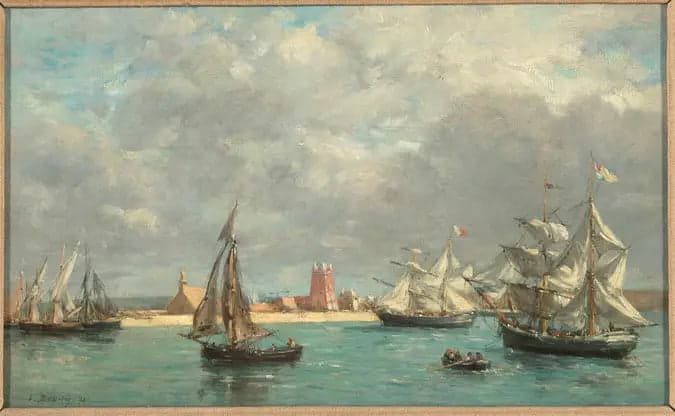
The Port of Camaret
- Original dimensions
- 59 x 36 cm
- Museum
- Orsay Museum
- Year
- 1872
Scene depicted
In The Port of Camaret , the composition reveals the emerging life of a Breton port. The white sails of the boats dance with the wind, and the reflections of light are immortalized on the water, reminding us of the ephemeral beauty of marine moments. This pictorial work depicts not only a place but a vibrant atmosphere, immortalizing the relationship between man and the sea.
Historical context
Created in 1872, The Port of Camaret is rooted in the picturesque port of Camaret-sur-Mer, a jewel of Brittany, emblematic of the Impressionist movement of which Boudin is one of the pioneers. This canvas summarizes an era when art opened up to light and sensation, capturing not only a scene but also the soul of a coastal region. Currently, this painting is exhibited at the Orsay Museum , where it radiates its magic to all who cross its path.
Place in the artist's career
Considered a pre- Impressionist masterpiece, The Port of Camaret is part of a significant period in Boudin's career, reflecting his evolution towards a freer expression. Compared to his other paintings such as The Beach of Trouville and The Fishing Boats , this painting reveals his growing attention to movement and light, marking a transition to a bolder style.
Anecdote
“Every day brings its share of wonders,” said Boudin, sitting on the beach of Camaret, his brushes in hand. His painting awakens memories of a sunny morning, where the gentle murmur of the waves and the sails of the boats are outlined on the canvas. It is in this enchanting setting that The Port of Camaret comes to life, a true cry from the heart in the face of the beauty of nature.