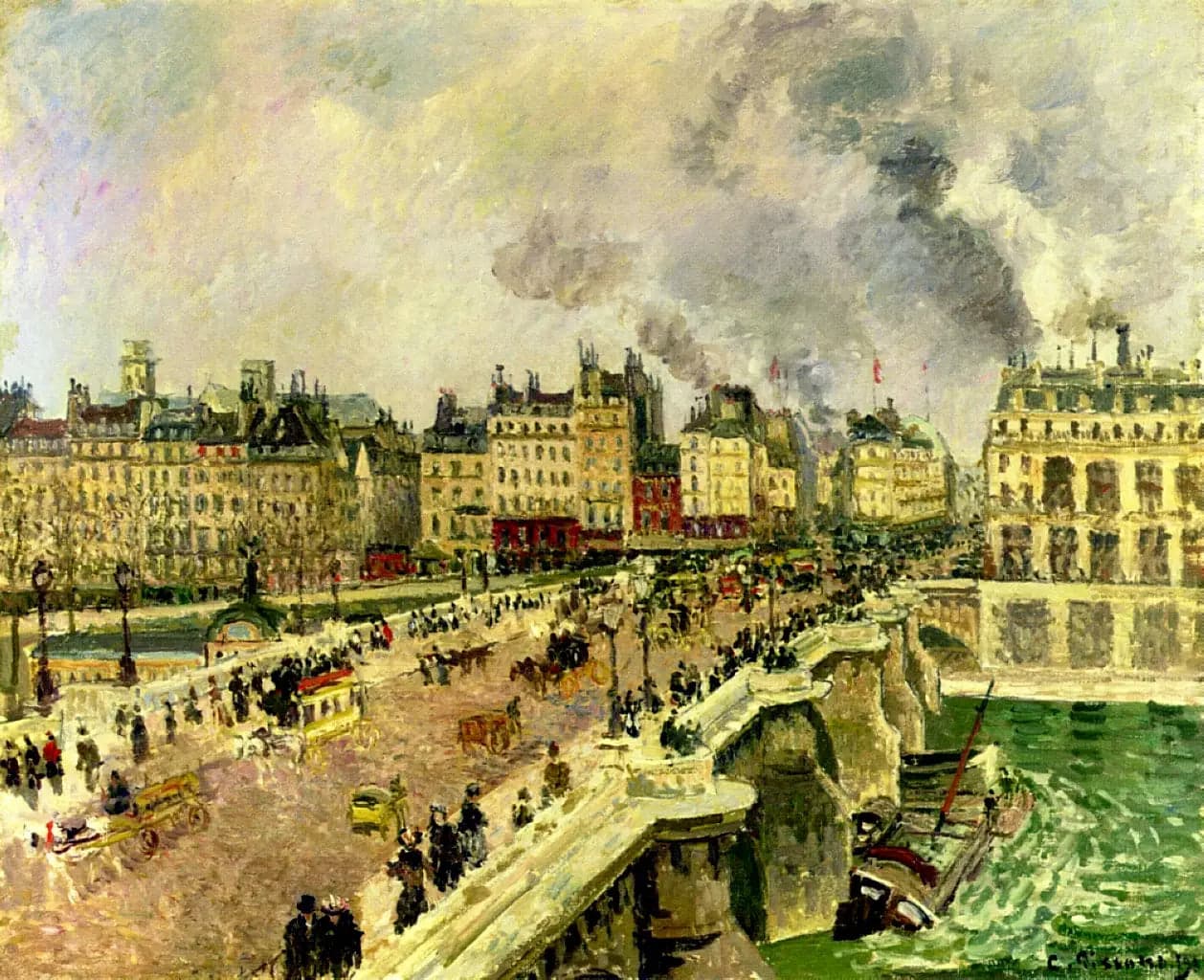
The Pont-Neuf, wreck of Bonne Mère
- Original dimensions
- 81 x 65 cm
- Museum
- Not specified
- Year
- 1901
Scene depicted
This iconic painting depicts the famous Pont-Neuf, as it was at the dawn of the 20th century, immersed in a nostalgic atmosphere. The silhouettes evoked by the canvas suggest a lively city, rocked by flashes of light and the murmurs of passersby. A snapshot of an era where refinement and the music of the Seine River waves mingled with the cries of merchants.
Historical context
Created in 1901, in the heart of Paris, this painting is emblematic of the Impressionist movement, a time when light and color took precedence over form. The canvas , which captures the melancholic beauty of a moment frozen in time, evokes the vibrancy of the city, where every street corner is a promise of escape. Today, its location remains mysterious, although its grandeur is undeniable.
Place in the artist's career
In Pissarro's career, The Pont-Neuf, wreck of Bonne Mère represents a high point of creativity. As a period of maturation, this work stands alongside The Road to Bagnoles at Éragny and The Seasons , revealing an increasing technical mastery and refined emotional sensitivity.
Anecdote
“Light and life are my true models,” could have said Camille Pissarro one spring morning, as he stood by the Pont-Neuf. It is in this vibrant and warm atmosphere that he captured the essence of Paris. Each brushstroke of this masterpiece is filled with emotions, merging the magic of the moment with the power of his art.