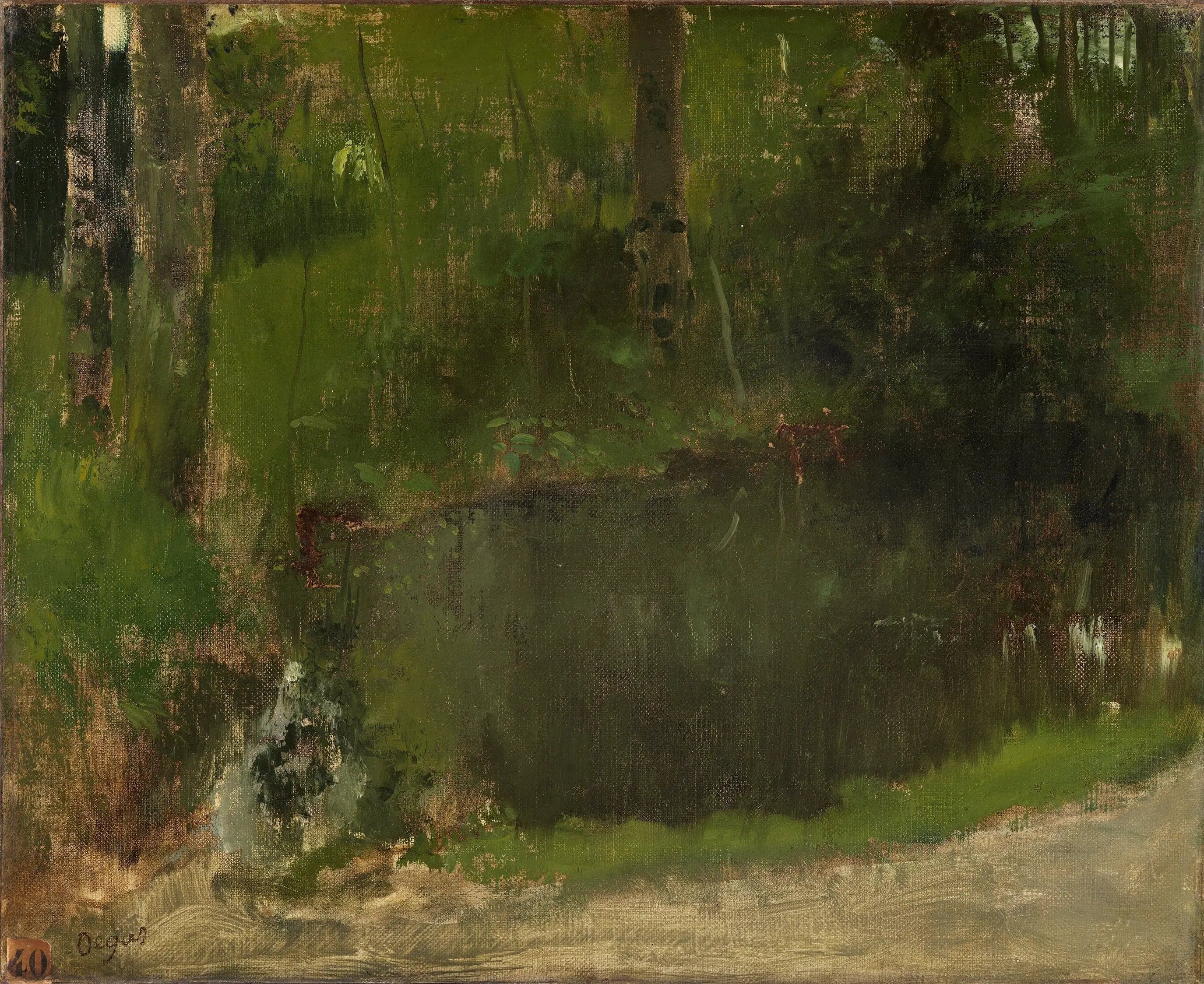
The Pond in the Forest
- Original dimensions
- 41.2 x 33.5 cm
- Museum
- Thyssen-Bornemisza Museum
- Year
- 1867
Scene depicted
Of exquisite serenity, "The Pond in the Forest" evokes a painting of lush nature. The composition embraces a rural environment where the surface of the pond reflects a vibrant sky. Massive trees frame the landscape, their foliage vibrant with an almost palpable luminosity. The work depicts a suspended moment, where calm prevails, and the harmony between man and nature is captured with delicacy and freshness.
Historical context
Created in 1867, the painting "The Pond in the Forest" is set against the backdrop of the city of Paris, at a time when the Impressionist movement begins to blossom. This canvas is emblematic of the innovative approach of Edgar Degas , an artist pushing the boundaries of classical pictorial representation. Currently, this work is preserved at the Thyssen-Bornemisza Museum , a true imprint of the 19th century where the soul of Impressionism comes alive through the delicate strokes of the painting .
Place in the artist's career
"The Pond in the Forest" is situated at a crucial stage in Edgar Degas's career. This painting demonstrates a turning point towards more introspective and poetic compositions. Alongside works such as "Absinthe" and "The Dance Class," Degas's style evolves towards a subtle exploration of light and space. Here, the painting shows us its ability to move away from human subjects to delve into vibrant nature.
Anecdote
Degas often said: "Painting is my tool to capture light and life." The inspiration for "The Pond in the Forest" came to him during one of his morning walks in the Parisian countryside. That morning, the gentle murmurs of the water, accompanied by the songs of birds, led him to immortalize this peaceful scene, the forest bathed in soft light, a moment of escape that is felt in every brushstroke of this masterpiece .