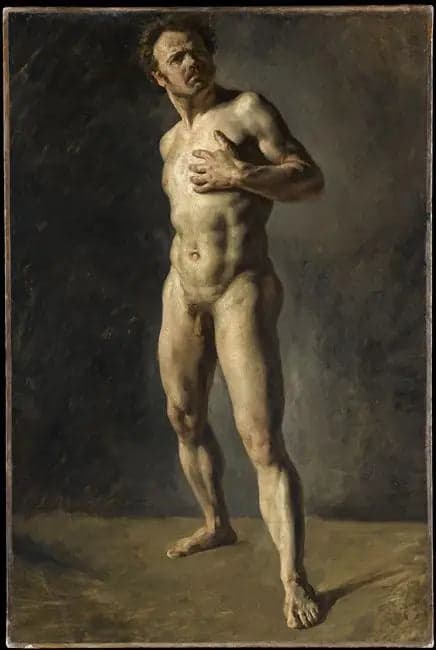
The Pole
- Original dimensions
- 54 x 80 cm
- Museum
- national museum Eugène-Delacroix
- Year
- 1821
Scene depicted
In this painting , Delacroix depicts a man with an emotional face, laden with feelings, who seems to gaze at the horizon in search of something lost. The drapery of his garment floats gracefully in the wind, while the background, blurred and suggestive, evokes a world in motion. This immersive composition, rich in emotions, pays tribute to the heroic spirit of the Polish people and highlights the duality of suffering and hope.
Historical context
Created in 1821, this iconic canvas by the romantic painter Eugène Delacroix finds its origin in the heart of Paris, a vibrant city then in full cultural effervescence. The work is situated in a rich historical context, marked by struggles for freedom and individual expression. This masterpiece is today carefully preserved at the national museum Eugène-Delacroix, where it continues to fascinate with its intensity and luminous beauty.
Place in the artist's career
The Polish represents a major step in Delacroix's stylistic evolution, marking a period of artistic maturation. Compared to other iconic works like Liberty Leading the People or The Massacres of Scio , this painting highlights a more personal and introspective approach, exploring themes of identity and human emotion with delicacy.
Anecdote
“When I paint, I seek only to capture the whispers of the heart,” said Delacroix, evoking the inspiration that assailed him one autumn evening as he contemplated the silhouette of a Polish soldier, emblem of bravery and melancholy. This canvas, The Polish , is thus a reflection of this fleeting encounter where art transcends the everyday.