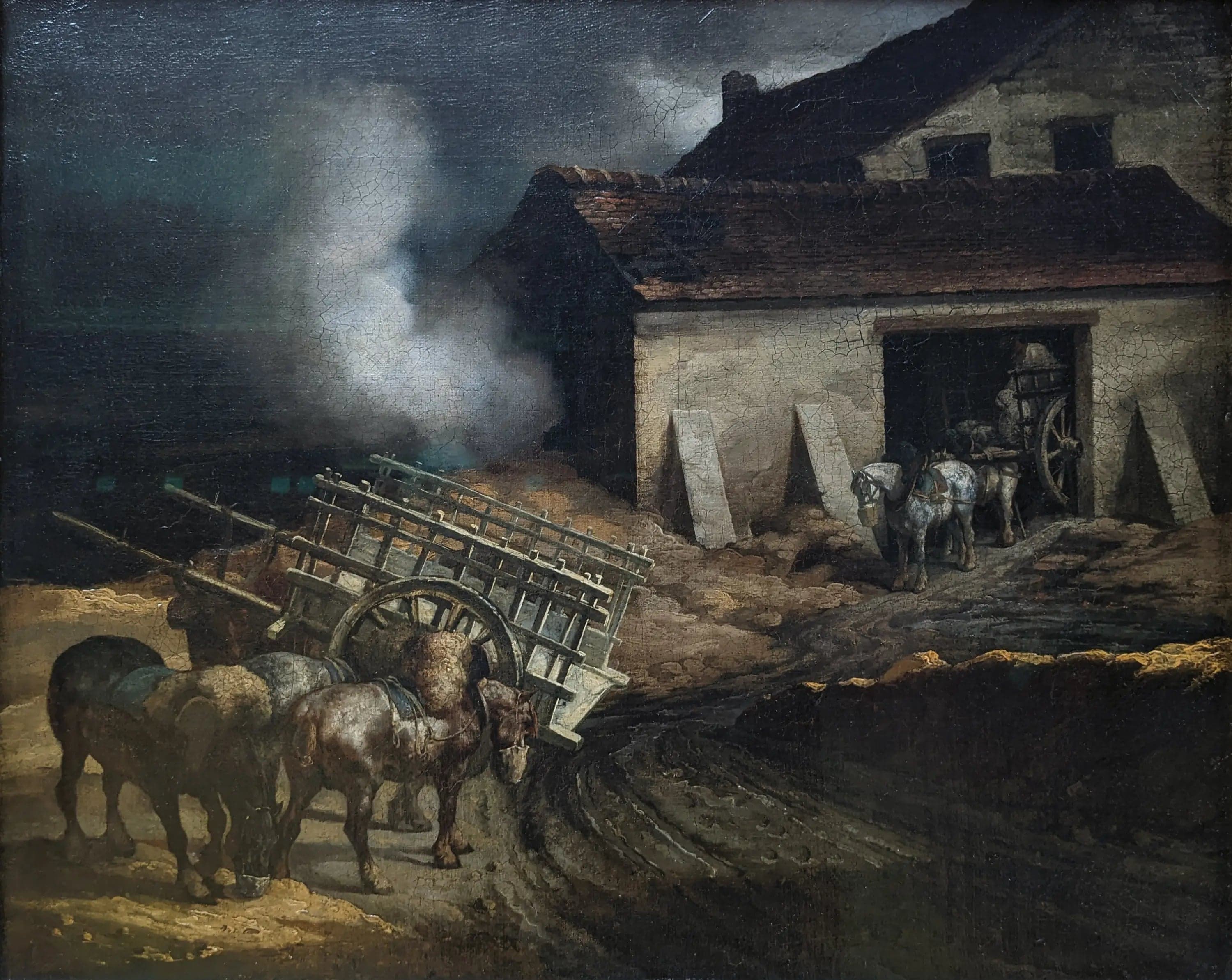
The Plaster Oven
- Original dimensions
- 61 x 50 cm
- Museum
- room 941
- Year
- 1821
Scene depicted
This painting immerses us in the heart of a working scene, revealing the daily life of artisans with striking truth. In the golden light, the elements of the scene come to life: the plaster kiln, a symbol of craftsmanship, becomes the silent witness of human efforts. The dynamic between the human figures and their environment creates an atmosphere laden with history, where each brushstroke tells a part of material and emotional truth.
Historical context
Created in 1821 in Paris, during a period when the romantic movement was beginning to assert itself, The Plaster Kiln is a sublime illustration of the talent of Théodore Géricault . This enchanting pictorial work is currently housed in the museum, room 941, where it continues to dazzle visitors with its composition and intense evocation of craftsmanship. Through this painting , the artist captures the very essence of his time, while allowing us to explore the nuances of the human condition.
Place in the artist's career
The Plaster Kiln occupies an essential place in the artistic trajectory of Théodore Géricault . This painting marks a period of maturity, where the artist, after works like The Raft of the Medusa and The Officers of the Imperial Guard , begins to reinterpret everyday life with emotional depth and striking realism. Géricault, through this painting , reveals a new dimension of his talent, inscribing his name in the history of art.
Anecdote
“I have always found inspiration around the corners of Paris, where light dances on matter and shadows tell stories.” These words resonate powerfully every time one contemplates this masterpiece . Imagine Géricault, in front of his easel, in the early morning, when twilight awakens and the world around him dresses in fatigue, ready to discover wonders through his canvas .