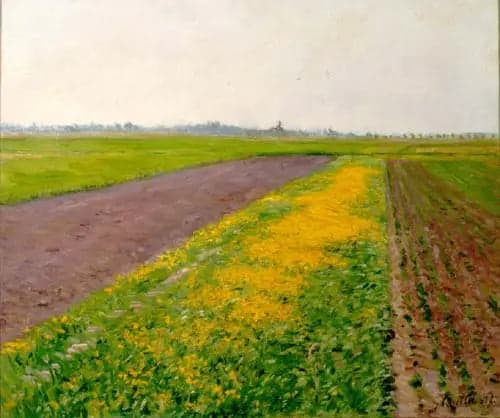
The Plain of Gennevilliers
- Original dimensions
- 65 x 54 cm
- Museum
- Botero Museum
- Year
- 1884
Scene depicted
This canvas transports the viewer into a vast green space, where the light of a calm day filters through a clear blue sky. In the distance, the shapes of the hills and a serene atmosphere combine to offer a scene that is both dynamic and soothing. The meticulous details of the landscape, combined with bold compositional choices, make it an essential painting of the Impressionist period.
Historical context
Created in 1884, this painting is an emblematic reflection of the Impressionist movement that emerged in Paris. Caillebotte, a man of rare artistic sensitivity, conveyed through this canvas his love for nature and his meticulous observation of Parisian landscapes. The canvas is currently housed in the Botero Museum, revealing all the richness of its dimensions of 65 x 54 cm.
Place in the artist's career
The Plain of Gennevilliers is situated at a turning point in Caillebotte's career. At this time, he becomes a pioneer of the Impressionist movement, standing out for his innovative technique. Compared to his other canvases , such as “The Bridge of Europe” and “The Floor Scrapers,” this painting embodies a technical richness and a growing desire to capture real life.
Anecdote
“I wanted to capture the fleeting light of a summer morning.” This quote from Caillebotte resonates as a tribute to the inspiration that led him to create this masterpiece . Imagine him, in the gentle sun, wandering through the plain, absorbing every nuance of color to immortalize. This pictorial work is a true ode to ephemeral beauty.