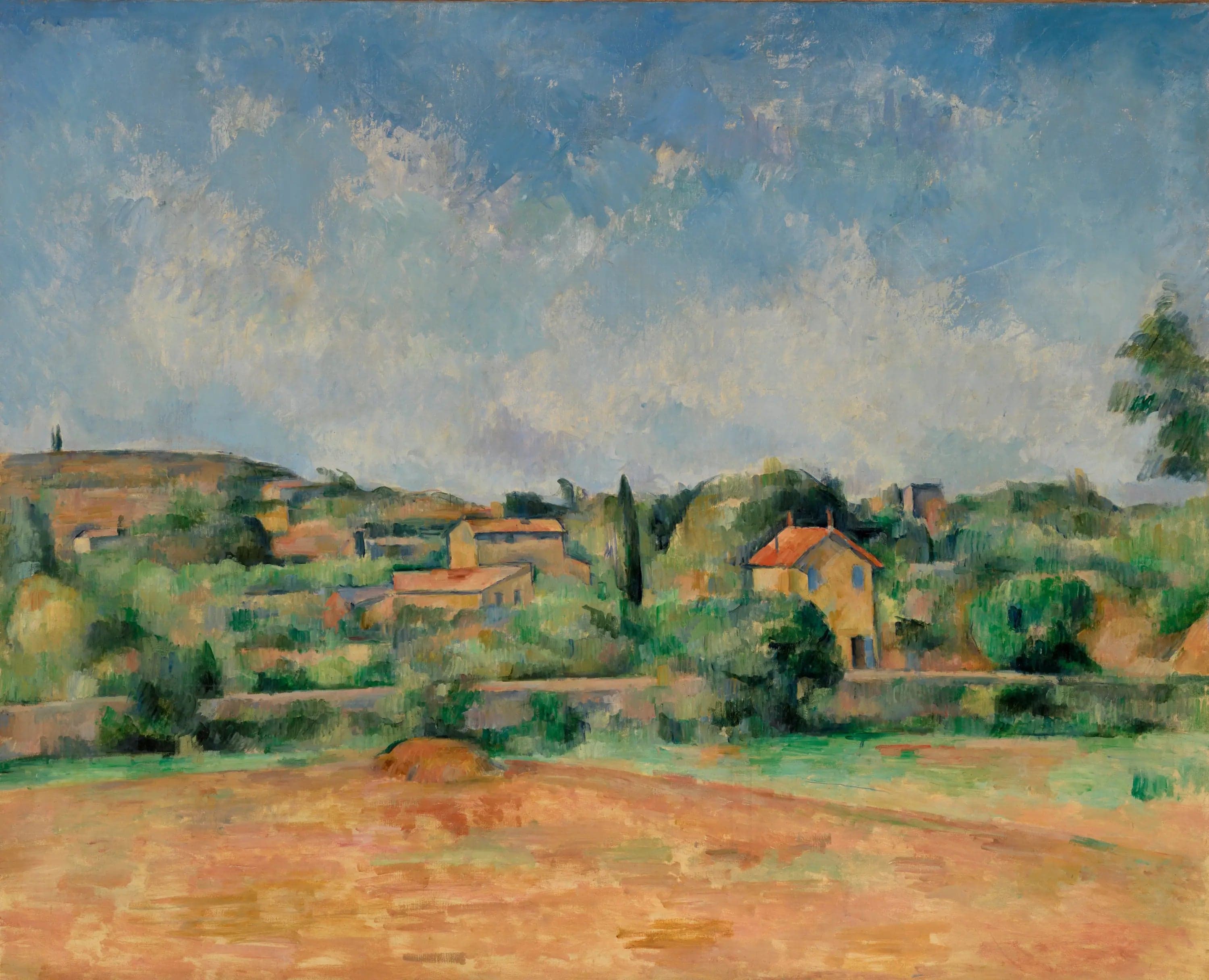
The Plain of Bellevue, also called The Red Lands
- Original dimensions
- 100 x 81 cm
- Museum
- Barnes Foundation
- Year
- 1891
Scene depicted
In this canvas , Cézanne invites the viewer to dive into a lush landscape, where the harmony of shapes and colors intertwines subtly. The rolling hills are adorned with red and green, while the azure sky offers a luminous setting. As the gaze lingers on each detail, one feels a deep connection with nature, an atmosphere of peace and contemplation envelops the observer.
Historical context
The iconic painting "La Plaine de Bellevue, also known as Les Terres Rouges" was created in 1891, in the heart of Provence, a region bathed in light and vibrant colors. Paul Cézanne , a pioneer of the post-impressionist movement, offers us here a canvas imbued with his desire to capture natural beauty from a geometric perspective. Today, this painting is preserved at the Barnes Foundation , where it continues to inspire generations of art lovers. Its dimensions, 100 x 81 cm, make it both an imposing and intimate composition.
Place in the artist's career
"La Plaine de Bellevue, also known as Les Terres Rouges" marks a key period in Cézanne's artistic evolution. This painting comes at a time when the artist seeks to renew his vision. In parallel, one can mention works like "The Large Bathers" and "Mont Sainte-Victoire," which testify to his unique approach and desire to experiment with color and light.
Anecdote
"To look at a landscape is to see it transform at every moment," Cézanne said while contemplating the valley from Bellevue. One spring morning, the scents of wildflowers dance in the air, the songs of birds resonate in the distance, and it is this melody of nature that nourished the soul of this masterpiece . Inspiration, like a caress, emerges from the ochre soil of Les Terres Rouges.