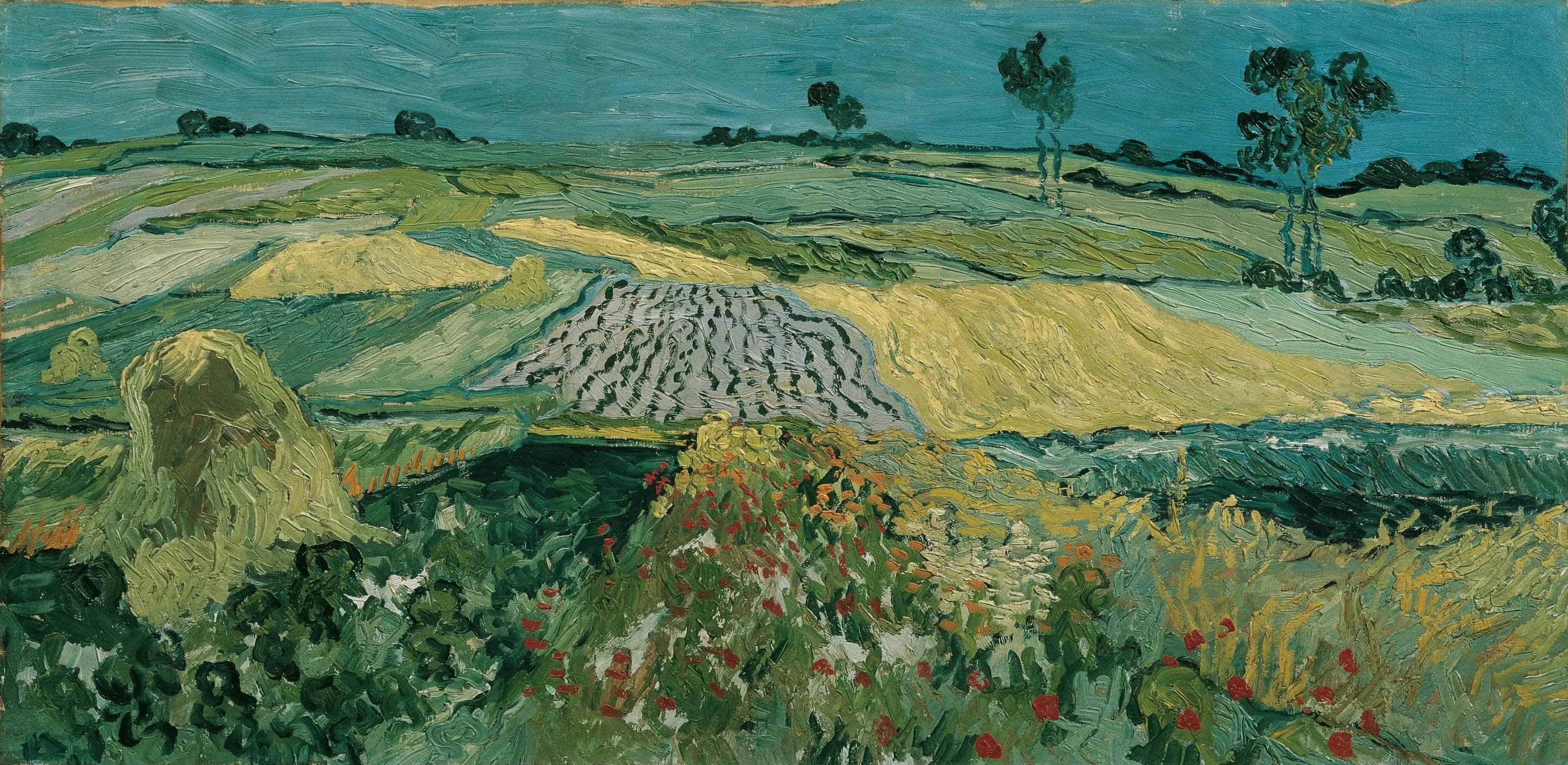
The Plain of Auvers
- Original dimensions
- 101 x 50 cm
- Museum
- Österreichische Galerie Belvedere
- Year
- 1890
Scene depicted
The Plain of Auvers depicts a vast luminous field, under a sky filled with heavy clouds battling with the sun. The rich shades of green, combined with bright touches of yellow, create a dynamic tableau that celebrates the meeting between earth and sky. This landscape , anchored in Van Gogh's memories, is not only an external representation but also a reflection of his tormented soul.
Historical context
Created in 1890, this painting is emblematic and was born in the charming village of Auvers-sur-Oise , a favored place by artists of the time. Representative of Post-Impressionism , The Plain of Auvers embodies the stylistic and emotional culmination of Vincent van Gogh , as he explores the vibrant and substantial beauty of the landscapes of France. Today, the painting is preserved at the Österreichische Galerie Belvedere , where it continues to amaze visitors.
Place in the artist's career
The Plain of Auvers marks a crucial point in the career of Vincent van Gogh , positioning itself at the crossroads of his periods of experimentation and revelation. Alongside works such as The Wheat Field with Crows and Café Terrace at Night , this masterpiece testifies to an evolution marked by an increasingly assertive gesture and unprecedented chromatic intensity. The Plain of Auvers, through its evocative power, embodies the peak of his creativity before his tragic disappearance.
Anecdote
Van Gogh once stated about his creative process: “I dream my painting, and then I paint my dream.” One sunny morning in May, as the first rays of sunlight caress the generous plain of Auvers, he was struck by the ephemeral beauty of this landscape . This canvas , a product of his inspiration, is its brilliant reflection, capturing the fleeting moment of nature at its peak.