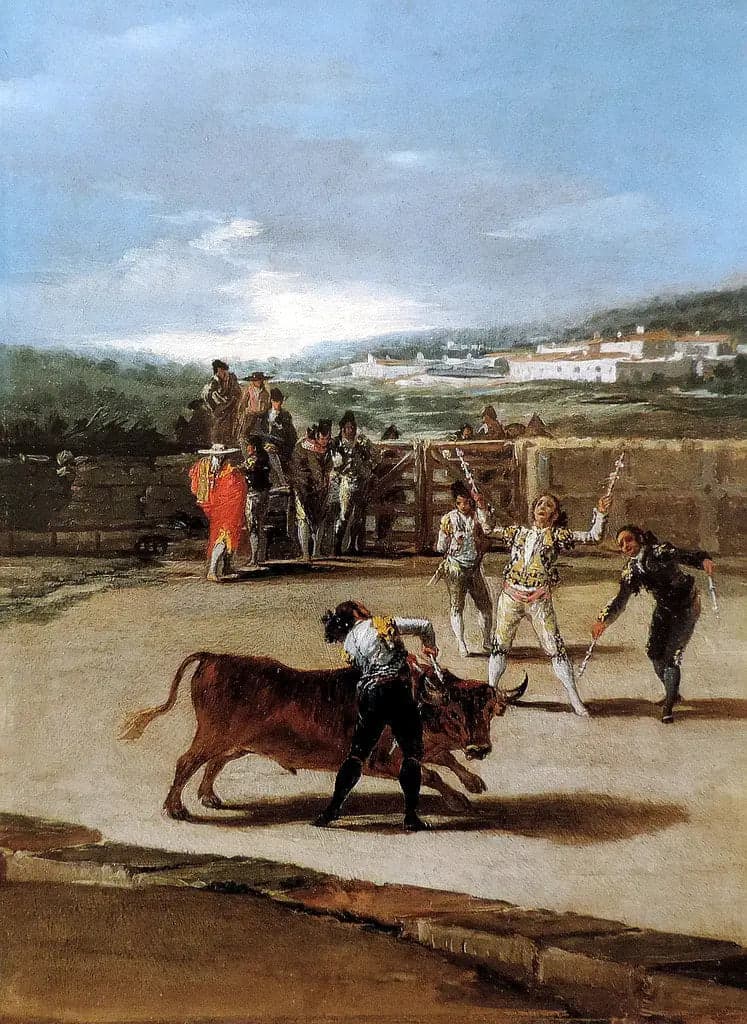
The Placement of the Banderillas
- Original dimensions
- 32 x 43 cm
- Museum
- Museum of Fine Arts of Asturias
- Year
- 1793
Scene depicted
The Placement of the Banderillas captures a decisive moment in the spectacle of bullfighting. This composition depicts an elegant torero, ready to face the bull, enveloped in palpable tension. Goya, through his brilliant technique, captures the movement that is both majestic and brutal, highlighting the passion and drama inherent in this Spanish tradition. The spectators, the intense light, and the floating dust create an immersive atmosphere, where every detail seems to vibrate with life.
Historical context
Created in 1793, The Placement of the Banderillas is an iconic painting by the famous Spanish artist Francisco de Goya . This painting is currently housed in the Museum of Fine Arts of Asturias, in the charming city of Oviedo, Spain. This canvas , created during a period of social and political turmoil, is part of the Romanticism movement. It reflects the artist's deep sensitivity to his tumultuous times.
Place in the artist's career
The Placement of the Banderillas represents a crucial phase in Goya's career. It symbolizes his transition from a classical style to a more introspective and emotional approach. Alongside masterpieces such as the famous Starry Night and Las Meninas, Goya demonstrates an increasing mastery of color and composition, transforming the perception of the painting of his time.
Anecdote
“Light and shadow in the arena speak more than a thousand words.” This quote could summarize the moment when Goya, sitting in a corner of the arena, observed the excitement of the bullfighting. That morning, the vibrant atmosphere, the smell of damp clay mixed with that of excited spectators, inspired the emotional power of this pictorial work .