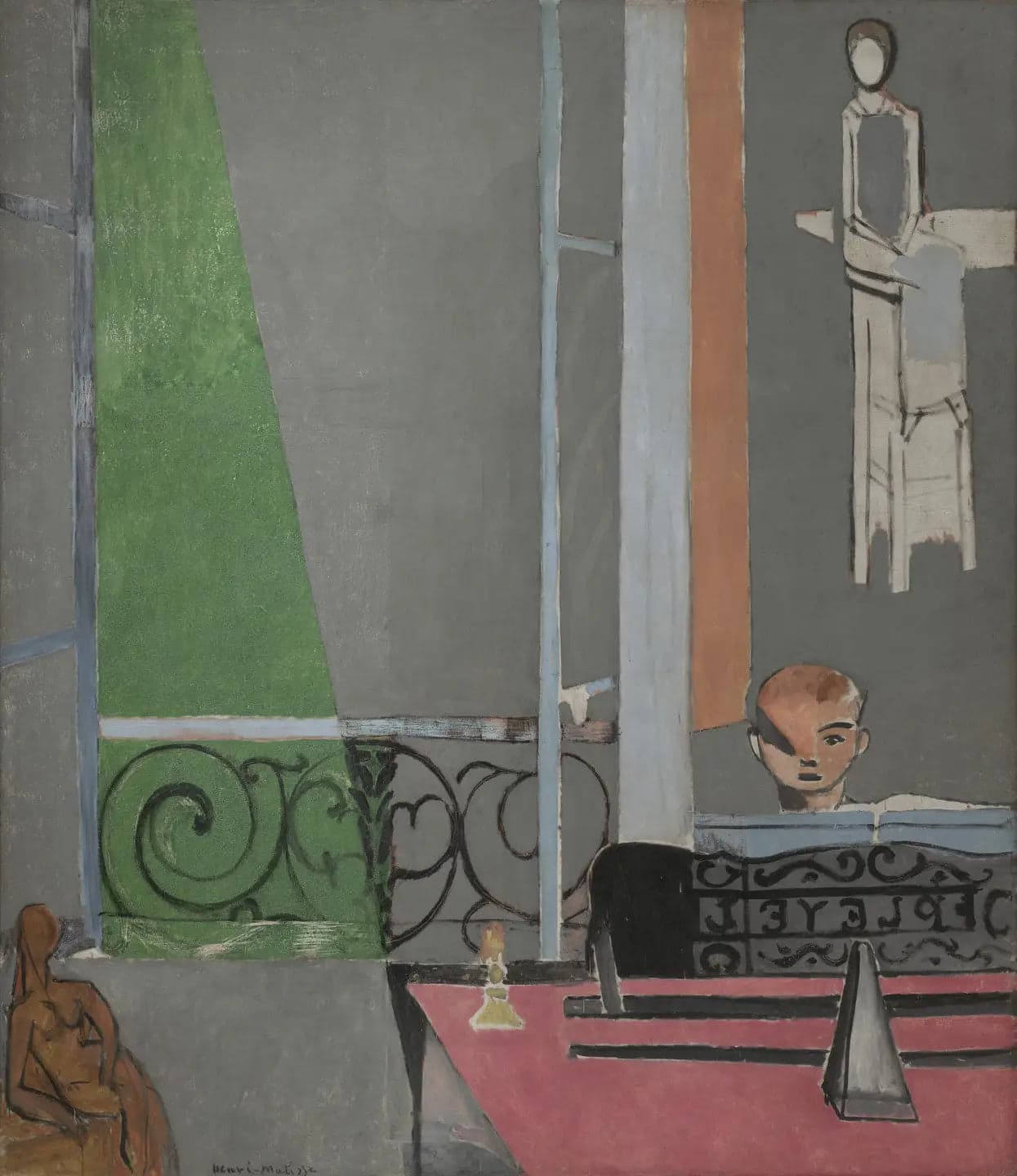
The Piano Lesson
- Original dimensions
- 212.7 x 245.1 cm
- Movement
- cubism
- Museum
- Museum of Modern Art
- Year
- 1916
Scene depicted
This painting illustrates a piano lesson where a musician teaches a student, creating a suspended moment between learning and the beauty of music. The geometric lines and bold colors of the painting highlight the silent dialogue between the artist, the student, and the piano, transforming this moment into a captivating visual composition that invites contemplation.
Historical context
Created in 1916 in Issy-les-Moulineaux, The Piano Lesson is part of the cubist movement, a period when Matisse explores the deconstruction of forms. At that time, France was going through the turmoil of World War I, a reality that altered the artistic and human landscape. Currently, this canvas is housed at the Museum of Modern Art, in the heart of New York, and measures 212.7 x 245.1 cm. This iconic painting reflects a time of intense creativity and unprecedented experimentation.
Place in the artist's career
The Piano Lesson represents a turning point in Matisse's career, a work where his mature style emerges. It is interesting to parallel it with other paintings such as "The Dance" and "The Joy of Life," where the artist continues to deepen his use of forms and colors, reflecting a constant evolution towards a visual expression of emotion and sensation.
Anecdote
“Painting, for me, is like music; it requires a space of silence to resonate emotions.” These words from Matisse remind us of the inspiration he drew from a gentle spring morning while observing a tranquil scene at home. It is this atmosphere, both peaceful and musical, that emerges from The Piano Lesson , reinforcing the idea that painting is a sweet visual melody.