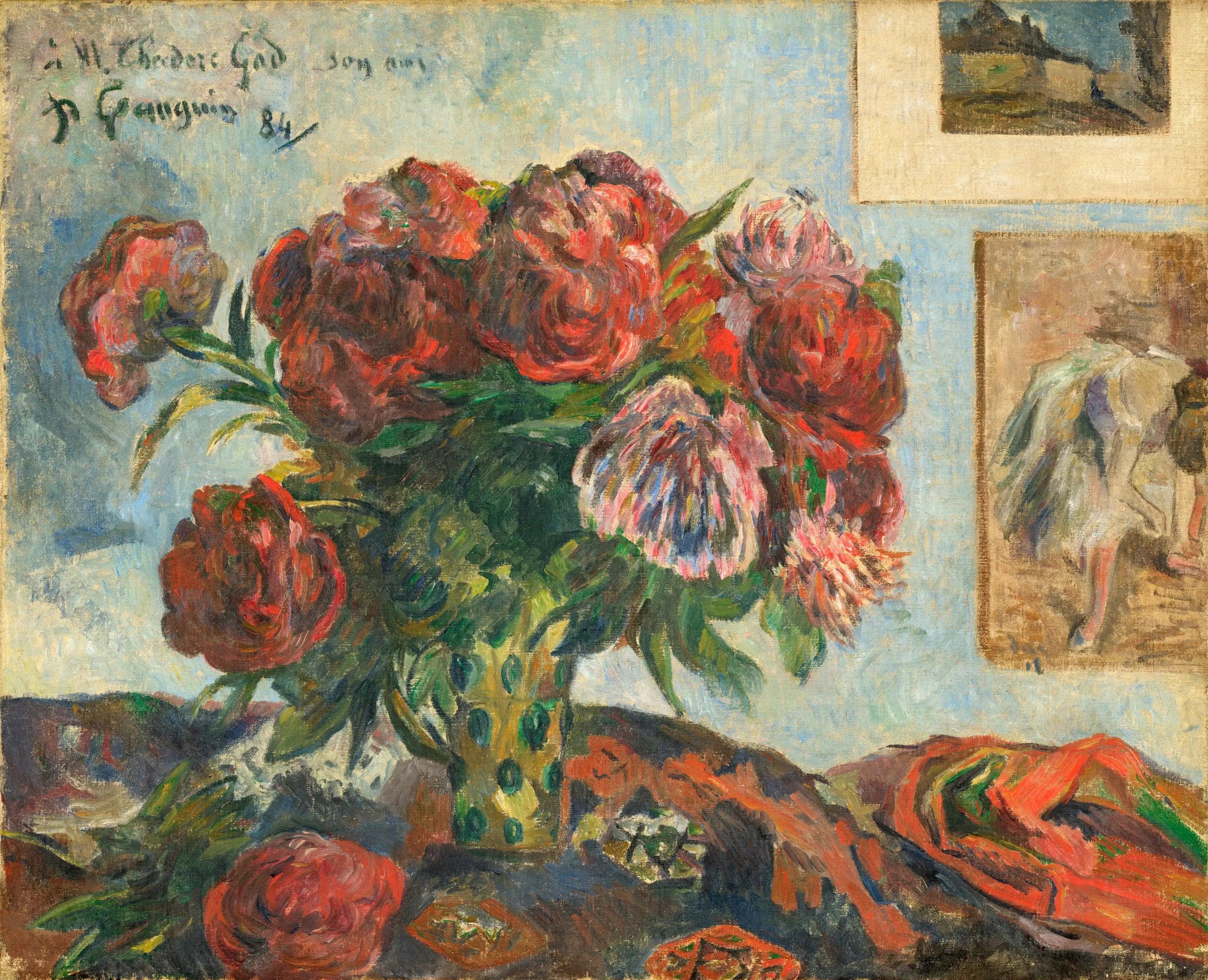
The Peonies I
- Original dimensions
- 73 x 59.7 cm
- Museum
- National Gallery of Art
- Year
- 1884
Scene depicted
In this painting, the floral lushness of the peonies is highlighted, revealing the harmony of colors and textures. The green leaves vibrate against the background, while the flowers, delicate and opulent, seem to reveal a soul in search of beauty. The composition expresses a deep serenity, a testament to a contemplative gaze upon nature.
Historical context
Created in 1884 in the vibrant city of Paris, the painting The Peonies I is part of the post-impressionist movement, a trend that frees itself from realistic constraints to explore emotions through color and form. This canvas emblematic, currently preserved at the National Gallery of Art , testifies to Gauguin's artistic flourishing, reflecting a time when the Parisian art scene was a true melting pot of culture.
Place in the artist's career
The Peonies I represents a significant step in Gauguin's career, echoing his exploration of forms and colors. This canvas , just like The Vision of the Sermon and Where Are We Going?, illustrates his evolution towards bolder abstraction, distancing itself from impressionist themes to explore a personal and spiritual depth.
Anecdote
“Nature inspires me, it whispers secrets that only the canvas can capture,” Gauguin is said to have remarked, one spring morning as he observed vibrant peonies, bright as his dreams. This fleeting moment became the creative spark for this masterpiece .