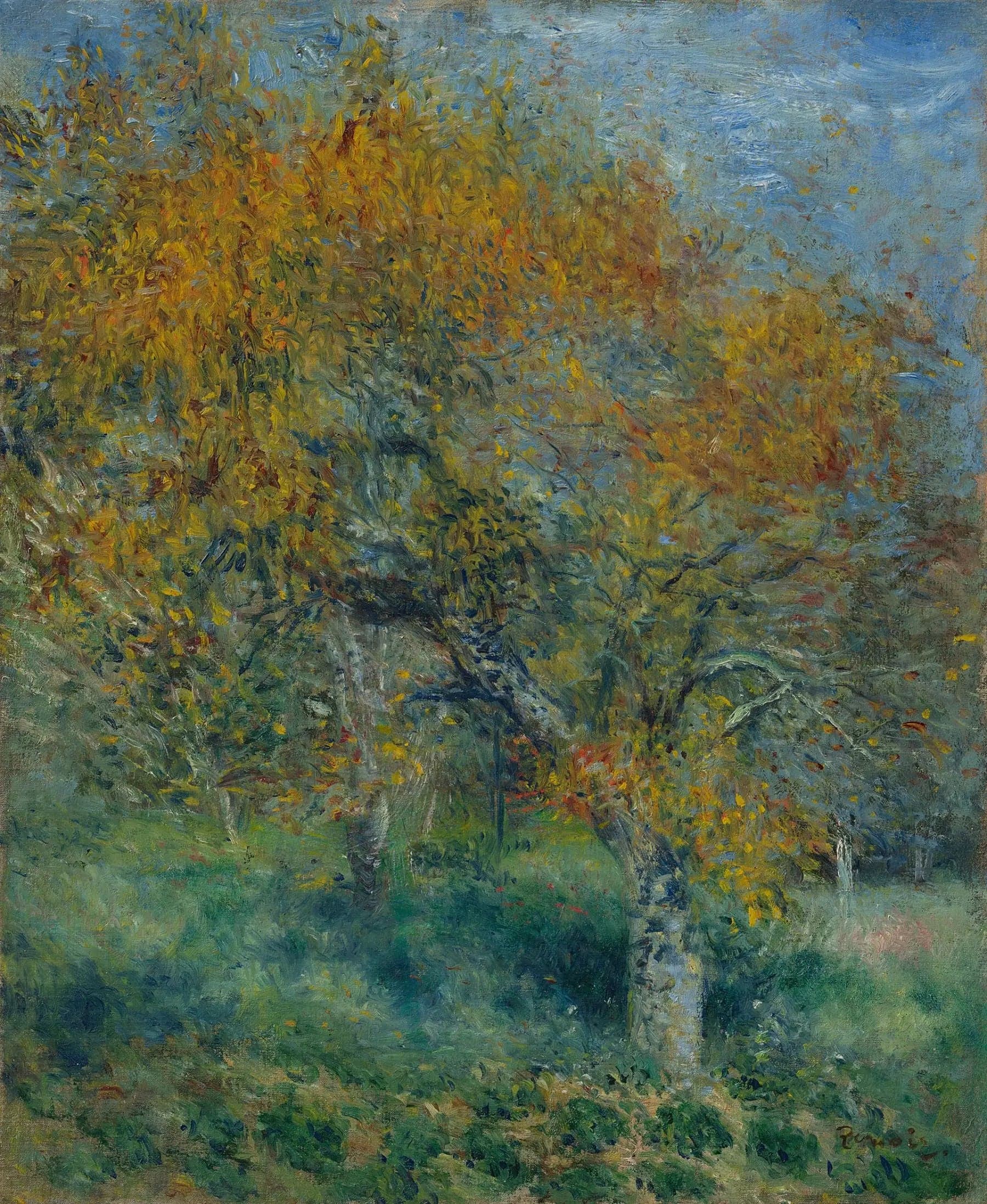
The Pear Tree - Pierre
- Original dimensions
- 37.7 x 46.1 cm
- Museum
- Barberini Museum
- Year
- 1877
Scene depicted
In this canvas , Renoir captures the essence of a peaceful day in the garden, where the majestic pear tree flourishes at the heart of the scene. The subtle play of light illuminates the leaves, while a blue sky, dotted with clouds, adds a touch of softness to the composition. This pictorial work embodies the perfect harmony between nature and the artist, united in a shared grace.
Historical context
Created in 1877, this painting is an iconic piece of the Impressionist movement, located in Potsdam, Germany. At that time, Renoir, a leading painter, continuously explored the effects of light and color, revolving around themes of nature and the joy of living. Today, this canvas is housed in the Barberini Museum , where it continues to captivate a wide audience with its brilliance and finesse.
Place in the artist's career
“The Pear Tree” stands as a crucial milestone in the career of Auguste Renoir , illustrating his now-iconic style. Between early canvases like “Dance at Le Moulin de la Galette” and later masterpieces such as “The Water Lilies,” this painting reflects an evolution where lightness and brightness find an irreplaceable echo. The artist, in a perpetual quest for emotions, here indulges in his passion for the delicacy of everyday moments.
Anecdote
“Light is color itself,” Renoir said, a sentiment he transcended while creating this masterpiece . Inspired by a bright morning, he set up with his canvas in an orchard, where the sweet scent of blooming pear trees surrounded him, awakening an irresistible desire to honor the ephemeral beauty of nature with this painting .