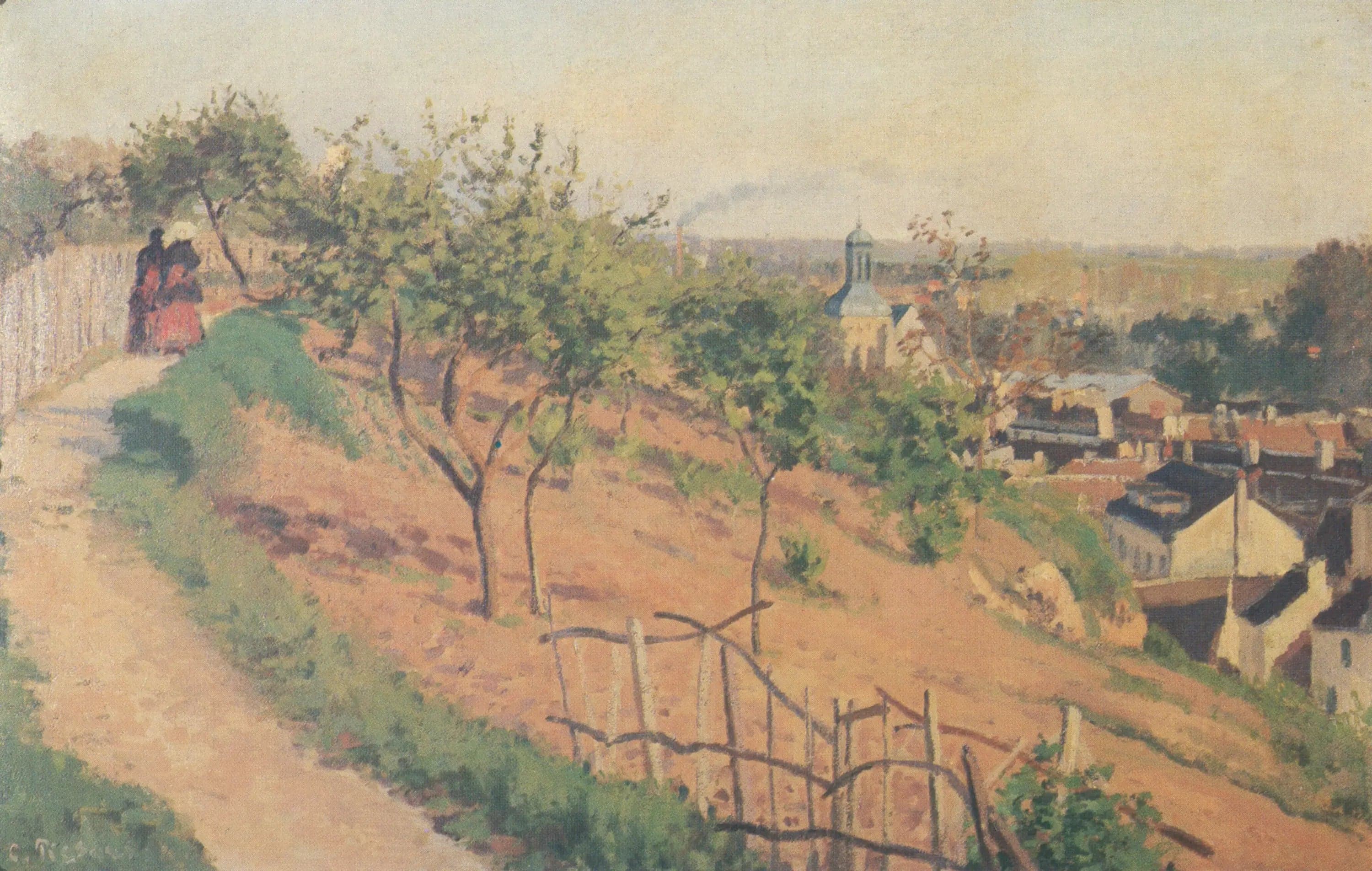
The Path of Justice, Pontoise
- Original dimensions
- 81 x 51 cm
- Museum
- Memphis Brooks Museum of Art
- Year
- 1872
Scene depicted
In this painting , Pissarro captures a suspended moment, where blurred figures traverse a tree-lined alley, illustrating the beauty of everyday life. The characters, who are sensed in slow movement, testify to the harmony that reigns in this place, between nature and humanity, reflecting an era when technology had not yet overtaken rural life. Each brushstroke, a promise of peace and tranquility, constitutes the very essence of the painting .
Historical context
Painted in 1872 in Pontoise, a charming town in Oise, the painting "The Path of Justice" reveals the simple beauty of rural life at the heart of the Impressionist period. This iconic work echoes the stylistic explorations of Camille Pissarro , one of the masters of the artistic movement that embraced light and nature. Today, this painting is housed in the Memphis Brooks Museum of Art, where it continues to enchant visitors with its simplicity and softness.
Place in the artist's career
"The Path of Justice" fits into a period where Pissarro explores his Impressionist roots, preceding paintings such as "Boulevard Montmartre, Spring" and "The Potato Harvest." This painting marks a turning point in his work, illustrating a shift towards a more striking emotional depth, while maintaining its simple and natural appearance.
Anecdote
As Pissarro said, "There is nothing more beautiful than capturing light in the early morning." That morning, as he wandered along the paths of Pontoise, inspired by the gentle rays of the sun filtering through the leaves of trees, he wanted to immortalize this peaceful scene. It is this connection with nature that nourished the soul of his masterpiece .