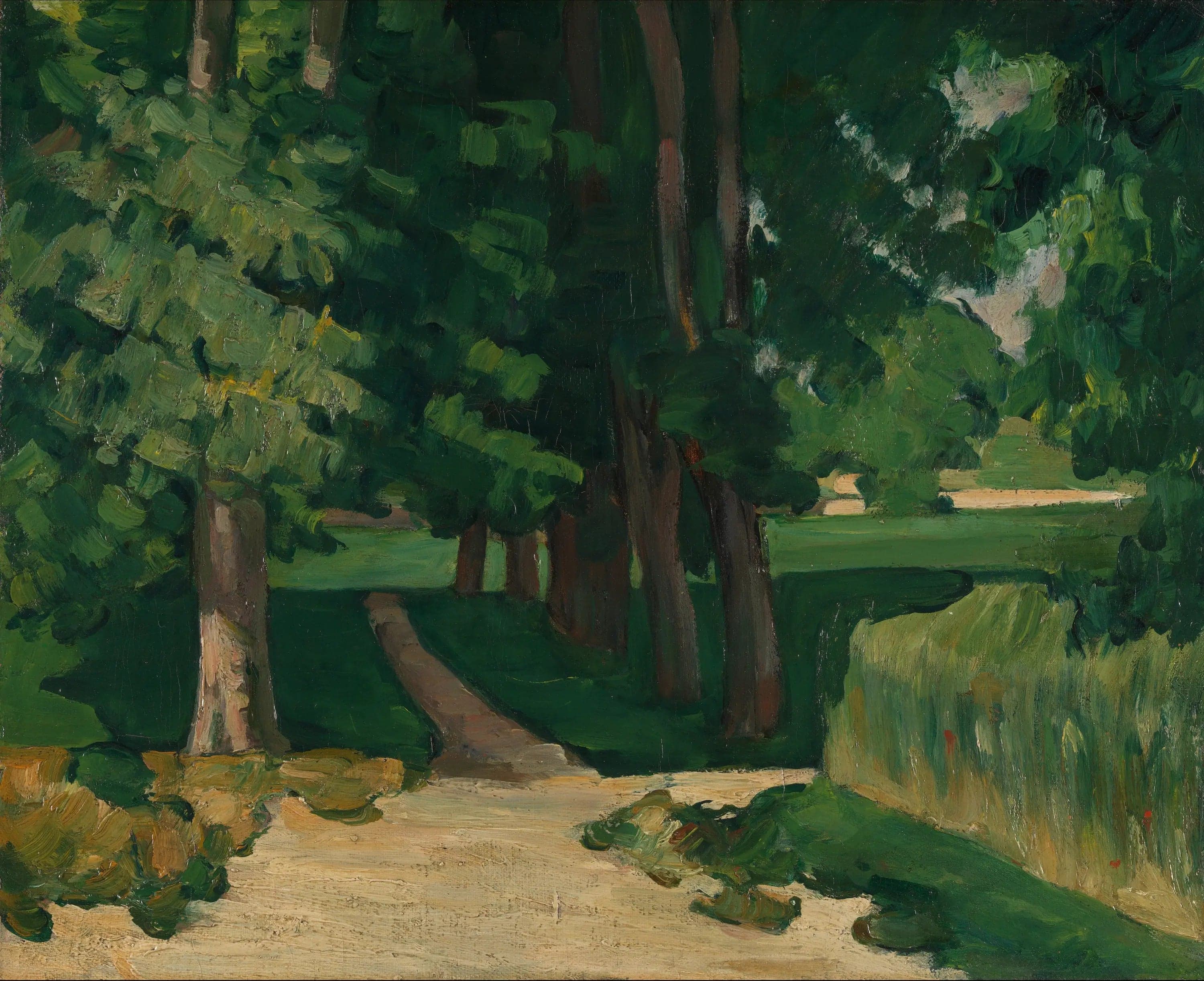
The Path at Jas de Bouffan
- Original dimensions
- 92 x 73 cm
- Museum
- Museum of Art and History of Geneva
- Year
- 1890
Scene depicted
In this canvas , the walker is invited to stroll along a shaded path, where nature reveals itself in a colorful and lively discourse. The trees, like sentinels, frame the winding path, while the filtered light creates a play of shadows and reflections, a harmonious tableau evoking the tranquility of the Provençal landscape.
Historical context
Created in the heart of summer 1890, this iconic work comes to life in the sunny region of Provence, more precisely in Aix-en-Provence. The Path at Jas de Bouffan is part of the Impressionist movement, reflecting a time when light and color govern painting. Currently, this painting is admired at the Museum of Art and History of Geneva , radiating its brilliance through the years.
Place in the artist's career
The Path at Jas de Bouffan marks a crucial step in Cézanne's career, a moment when he reaches remarkable artistic maturity. Alongside him, other famous paintings like The Montagne Sainte-Victoire and The Card Players illustrate his journey. This pictorial work is part of an evolution towards increasingly bold compositions, both visually and emotionally.
Anecdote
“I dream of a perfect form, but it is the soul of nature that I want to translate.” This quote reveals how Cézanne was in search of artistic transcendence. Inspired by a gentle morning, where the song of birds intertwined with the scents of flowers, he transformed this fleeting moment into a vibrant painting , capturing the very essence of The Path at Jas de Bouffan .