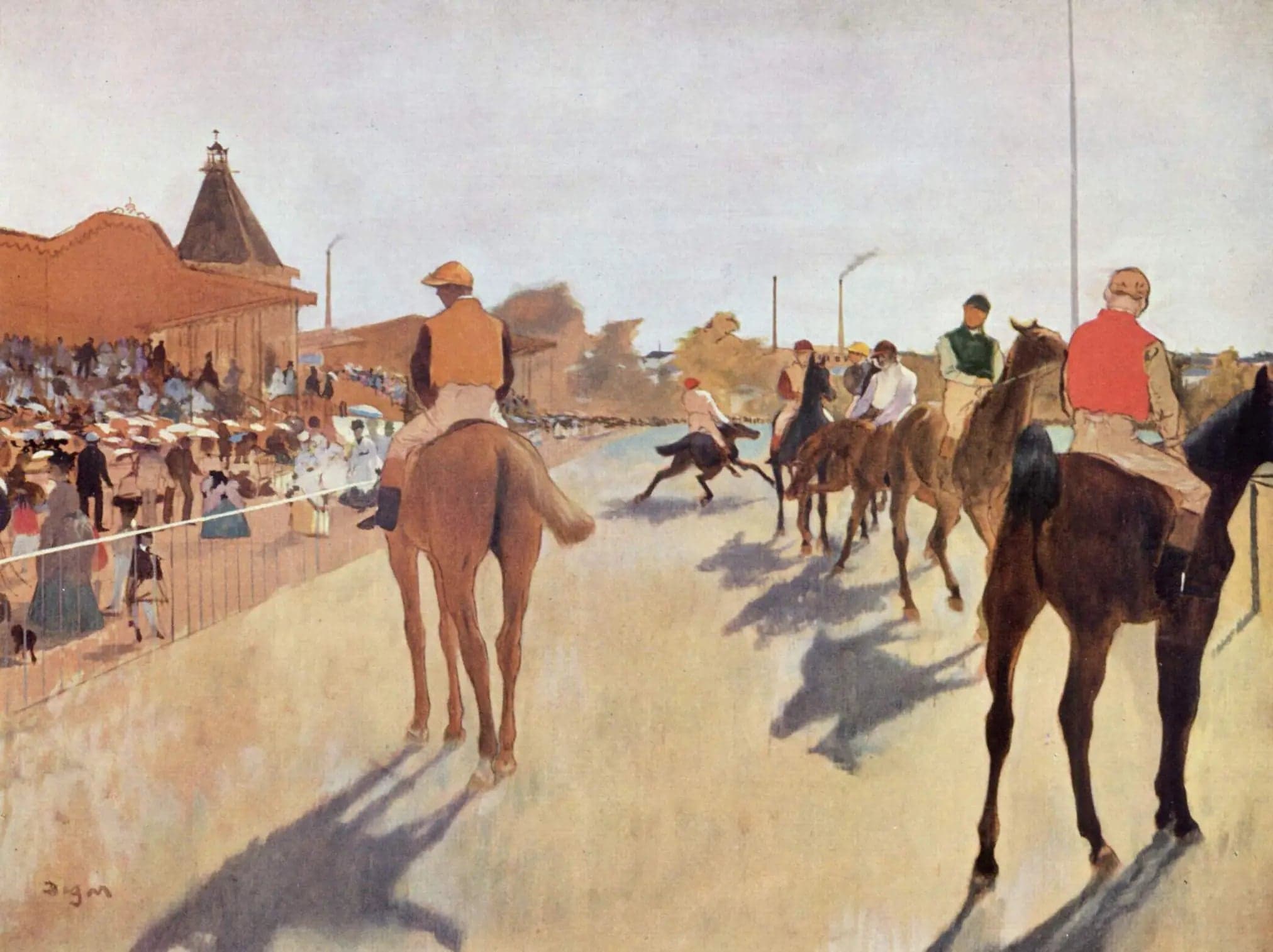
The Parade
- Original dimensions
- 61 x 46 cm
- Museum
- Orsay Museum
- Year
- 1866
Scene depicted
The Parade is a pictorial work that captures a lively scene of Parisian high society, the silhouettes of young women gracefully leaping in a ballet to a frantic rhythm. The themes of femininity and sociability, dear to Degas, come to life here, revealing a social dynamic where elegance and liveliness combine. The composition evokes movement, while forcing the viewer to contemplate the beauty of the clothing ornaments, the agility of the bodies, and the gaze of the passersby.
Historical context
Created in 1866, in the heart of Paris, this painting is the result of an impressionist measuring itself against the avant-garde movements of the time. The canvas is now located at the Orsay Museum , a true sanctuary of Parisian art, where it fascinates visitors with its vibrant atmosphere and its involvement in the impressionist movement. This attachment to the Parisian scene of the 19th century is also reflected in the precise dimensions of this work: 61 by 46 centimeters.
Place in the artist's career
This painting is part of a flourishing period in Edgar Degas 's career, marking a significant evolution in his style. Placed between The Dance Class (1874) and The Dancers at Rest (1879), The Parade shows a maturation in capturing movements and emotions. These canvases not only share similar themes but also a technique and a central vision that brilliantly traverse Degas's work.
Anecdote
“Life unfolds in a perpetual parade, capturing the moment is our challenge.” A phrase that seems to summarize the essence of Edgar Degas 's inspiration as he painted The Parade. Imagine this moment: a sunny morning, rays filtered through the trees, a light melody floating in the air, filled with the murmurs of the crowd. It is in this atmosphere that the artist felt the urgent need to capture the energy of a moment.
Major exhibitions
Paul Durand-Ruel, the bet of impressionism