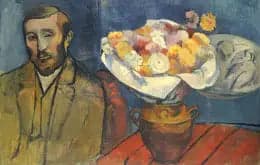
The Painter Slewinski
- Original dimensions
- 81.5 x 53.5 cm
- Museum
- National Museum of Western Art
- Year
- 1891
Scene depicted
The painting “Le Peintre Slewinski” masterfully illustrates the artist admiring and capturing his subject, a moment of introspection resonating with identity quest and intimate artistic search. The place, imbued with a dreamy atmosphere, transforms under and thanks to Gauguin's passionate gaze, revealing a poignant artistic identity.
Historical context
Created in the heart of 1891, this painting emerges from the creative mind of Paul Gauguin , an emblematic representative of Impressionist and Post-Impressionist movements. Located within the National Museum of Western Art , this canvas captivates with its colorful language and dynamism. It is in this rich and romantic setting that the artist transforms painful emotions and a quest for freedom into a vibrant painting .
Place in the artist's career
This canvas marks a turning point in Gauguin's career, highlighting his emergence as a major artist. In parallel with works like “Vision After the Sermon” and “Woman of Tahiti,” this painting bears witness to remarkable stylistic evolution and the maturity of his creative expressiveness.
Anecdote
“There are no holidays for an artist; every day is a new beginning.” In contemplating this pictorial work , one senses the dawn of a spring day, where the air is fragrant with garden flowers and the sun's rays gently caress the skin. This painting is a celebration of the moment, a precious capture of transcended reality.