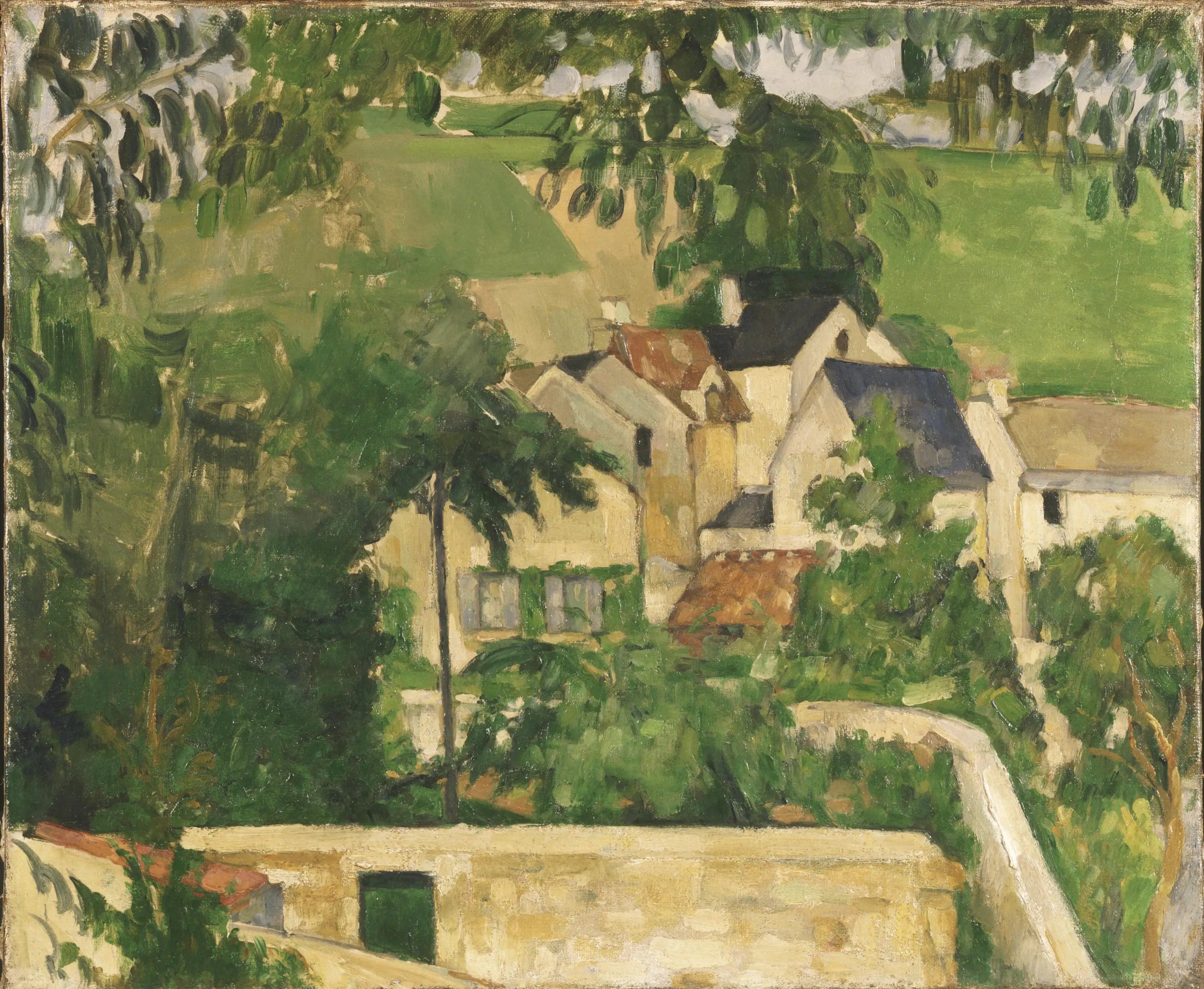
The Oven District in Auvers-sur-Oise
- Original dimensions
- 55.2 x 46.3 cm
- Museum
- Philadelphia Museum of Art
- Year
- 1873
Scene depicted
This immersive painting transports us into the daily life of Auvers-sur-Oise, where a picturesque neighborhood unfolds under Cézanne's brush. The landscapes, colorful and lively, tell a story of simplicity and natural beauty, each angle of the composition revealing a new aspect of this town that was the cradle of so many creators.
Historical context
Created in 1873, this iconic painting was born in the charming town of Auvers-sur-Oise, in the heart of the Île-de-France region. Paul Cézanne , a prominent figure of the impressionist movement, captures here the very essence of the era, blending pictorial innovation and precise observations of reality. The painting is now preserved at the Philadelphia Museum of Art , where it continues to inspire many art admirers. Its dimensions of 55.2 x 46.3 cm stand as a testament to its great artistic value.
Place in the artist's career
Positioned at the beginning of his career, The Quarter of the Oven in Auvers-sur-Oise represents a pivotal moment for Cézanne. This painting precedes other major works such as The Large Bathers and The Montagne Sainte-Victoire, marking his evolution towards bolder and more expressive compositions.
Anecdote
“Nature is everything to me. Every brushstroke must evoke the light and emotion of a moment.” These words of Cézanne resonate like an echo of his experiences through the seasons. The Quarter of the Oven in Auvers-sur-Oise thus comes to life on a cool morning, illuminated by a gentle sun, where each spatial scene transforms into a vibrant canvas of emotions.
Major exhibitions
First impressionist exhibition