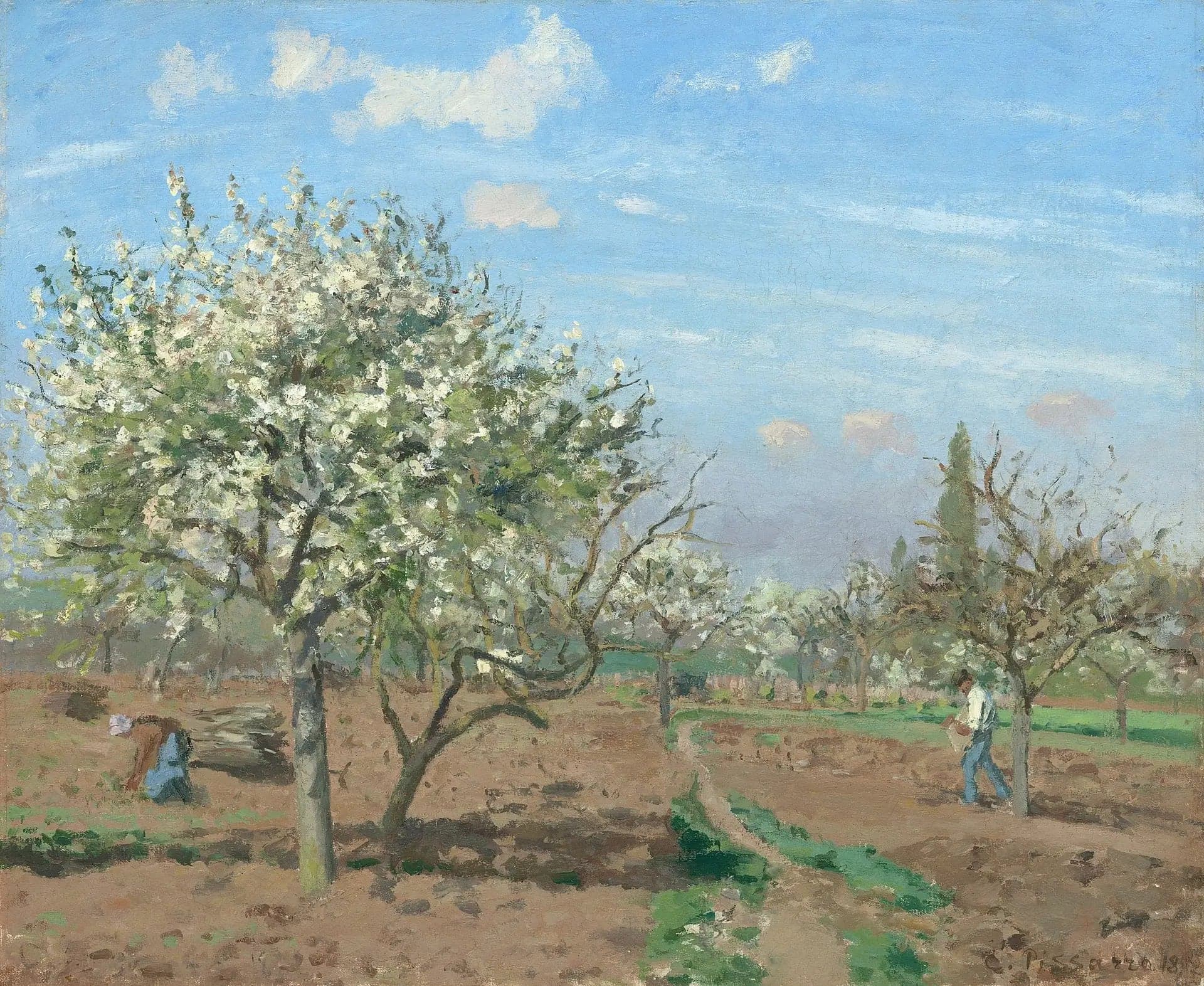
The Orchard
- Original dimensions
- 54.9 x 45.1 cm
- Museum
- National Gallery of Art
- Year
- 1872
Scene depicted
In "The Orchard," the gaze is immediately drawn to a vibrant display of colors, where flowering trees, basking in the gentle sunlight, stand majestically in a pastoral landscape. The painting evokes a poetic serenity, a fusion between nature and art, inviting the viewer to contemplate the ephemeral beauty of spring. The vibrant strokes and rich palettes make this pictorial work a true hymn to the floral season.
Historical context
Created in 1872, the painting "The Orchard" finds its roots in the historic town of Pontoise, France, at a time when impressionism was emerging as a major artistic movement. This canvas embodies not only the transformations of the era but also a quest for authenticity and personal expression. Today, this painting is displayed at the National Gallery of Art , testifying to its importance in the global artistic heritage.
Place in the artist's career
This painting , "The Orchard," marks a crucial milestone in Pissarro's career. It is both a technical and emotional culmination of his early impressionist explorations. Alongside works like "Boulevard Montmartre, spring" and "The Harvest of Potatoes," this painting showcases the evolution of his artistic sensitivity and mastery of light effects.
Anecdote
Pissarro, on a sunny spring morning, reportedly said: "The beauty of the blooming orchards touches my heart. I aspire to capture this moving delicacy in my painting ." This moment of inspiration was the prelude to his masterpiece , imbued with light and life.