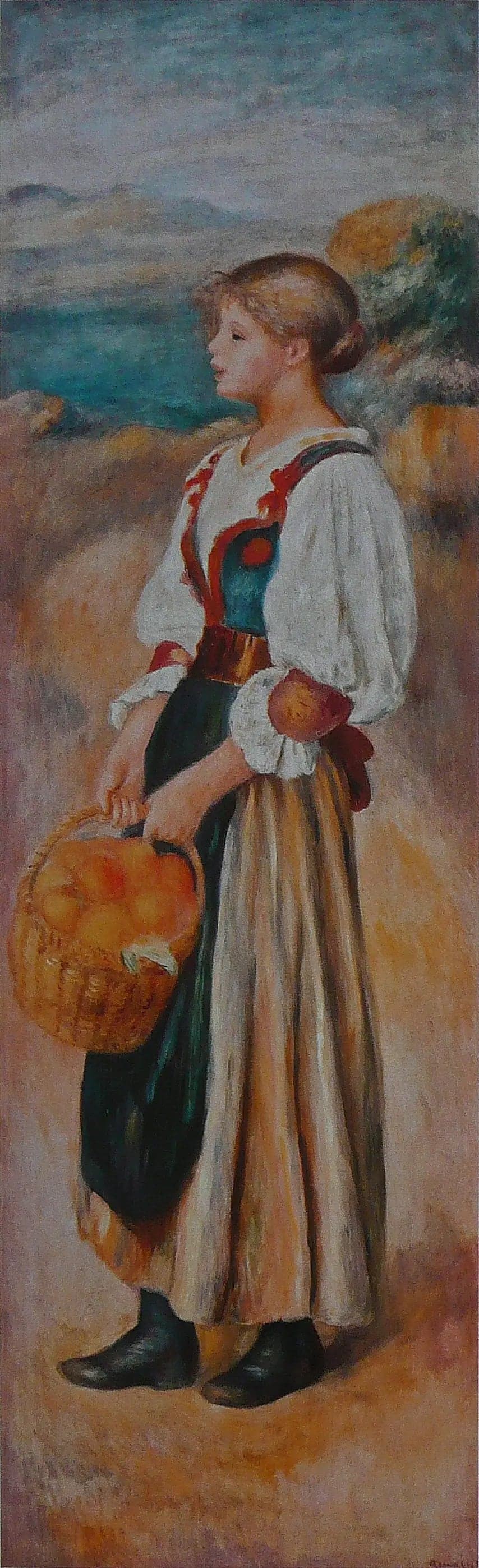
The Orange Seller - Pierre
- Original dimensions
- 41.8 x 128.8 cm
- Museum
- National Gallery of Art
- Year
- 1875
Scene depicted
The painting “The Orange Seller” depicts a woman in the midst of an open-air market, surrounded by a profusion of bright oranges. Her engaging posture and communicative smile give this painting an atmosphere of friendliness and warmth. Renoir invites us to savor this ephemeral moment, to appreciate the simple beauty of everyday life, while highlighting the richness of colors and the harmony of the composition.
Historical context
Created in 1875 in the vibrant city of Paris, The Orange Seller is at the heart of the Impressionist movement, an artistic current that was shaking the pictorial norms of the time. This iconic painting, currently housed at the National Gallery of Art , embodies the essence of a society in full transformation. View this masterpiece, measuring 41.8 x 128.8 cm, and let yourself be transported by its brilliance.
Place in the artist's career
This pictorial work marks a significant step in Renoir's career, where he executes a shift towards a more free style, characteristic of the Impressionist movement. In parallel, paintings like “Luncheon of the Boating Party” and “The Bathers of the Seine” reveal the evolution of his style, showcasing notable advancements in the use of light and the representation of human interactions.
Anecdote
Renoir once stated: “Light plays on the canvas like water on the leaves of trees.” Imagine him, on a bright spring morning, observing the lively life in a Parisian market. The display of yellow fruits, the sweetness of the oranges, and the joy of the customers inspired him to capture this effervescence in his painting. This vision is perceptible in The Orange Seller, where every color and every shape vibrate with intense life.