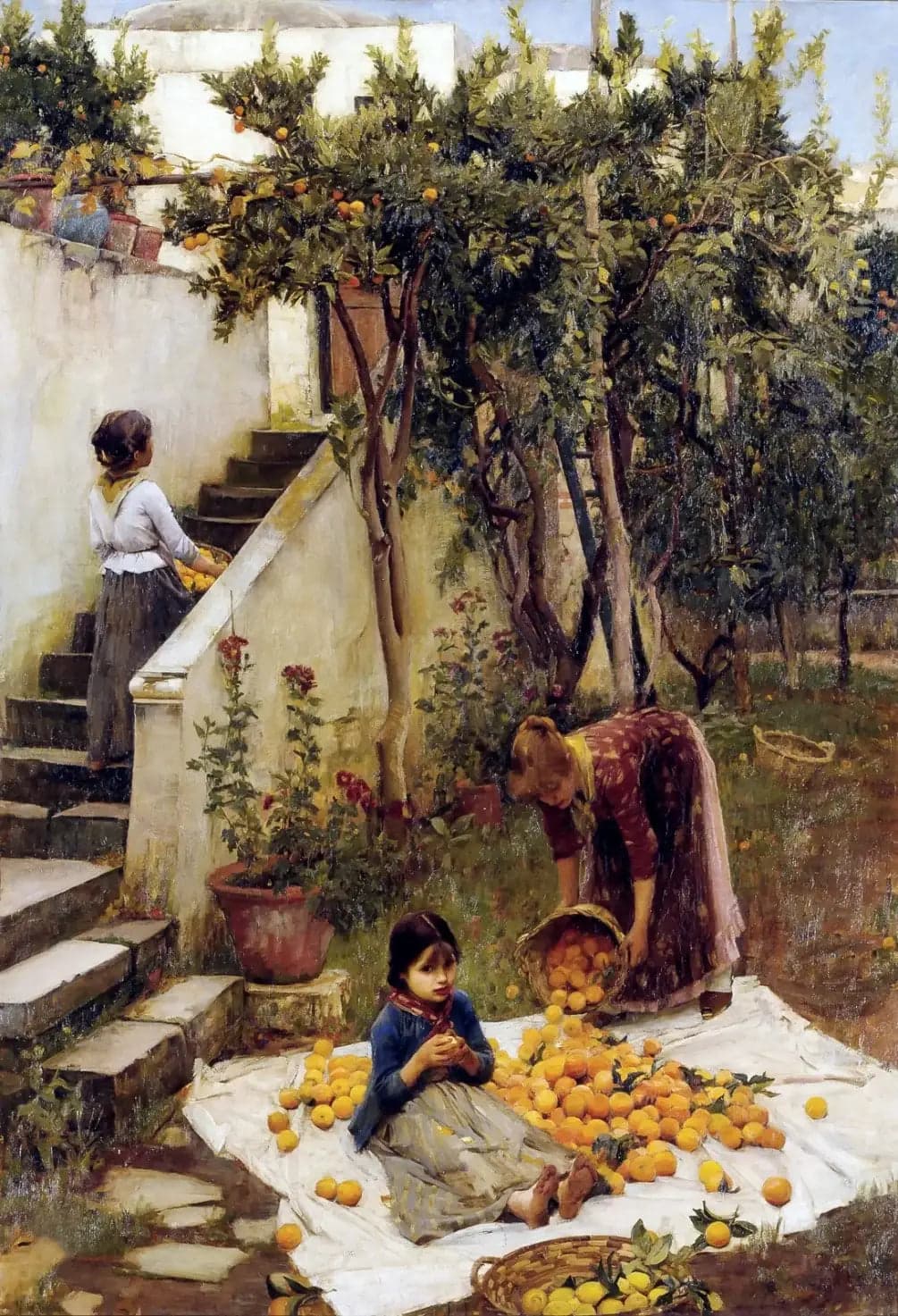
The Orange Pickers
Scene depicted
“The Orange Gatherers” is a celebration of life and nature, illustrating a bucolic scene where female figures are busy harvesting oranges, caught in a soft golden light. This painting evokes both grace and labor, symbolizing a harmony between man and the earth, and offers a poetic look at a simple moment, yet filled with delicacy.
Historical context
Created in 1908, this painting emblematic was born in London, United Kingdom, during a rich period of the Pre-Raphaelite movement, which valued the return to natural and romantic themes. The original work is currently preserved at the Manchester Museum, where it continues to attract the admiration of art enthusiasts. The canvas measures 147 x 252 cm, thus revealing the grandeur of this pictorial work .
Place in the artist's career
This painting represents a turning point in Waterhouse's career, consolidating his status as a master of Pre-Raphaelitism. When comparing this pictorial work to other canvases like “The Tempest” and “The Return of the Prodigal Son,” one notices an evolution in his treatment of light and emotions. The use of natural motifs and fluid compositions becomes a symbol of his artistic maturity.
Anecdote
“Each canvas is a window into the human soul.” It was while strolling through the sunlit gardens on a spring morning that Waterhouse saw, before him, inspiration come to life. The orange gatherers, elegant silhouettes amidst juicy fruit, embody the joy and beauty of this scene, plunging the viewer into a fragrant dream saturated with citrus scents.