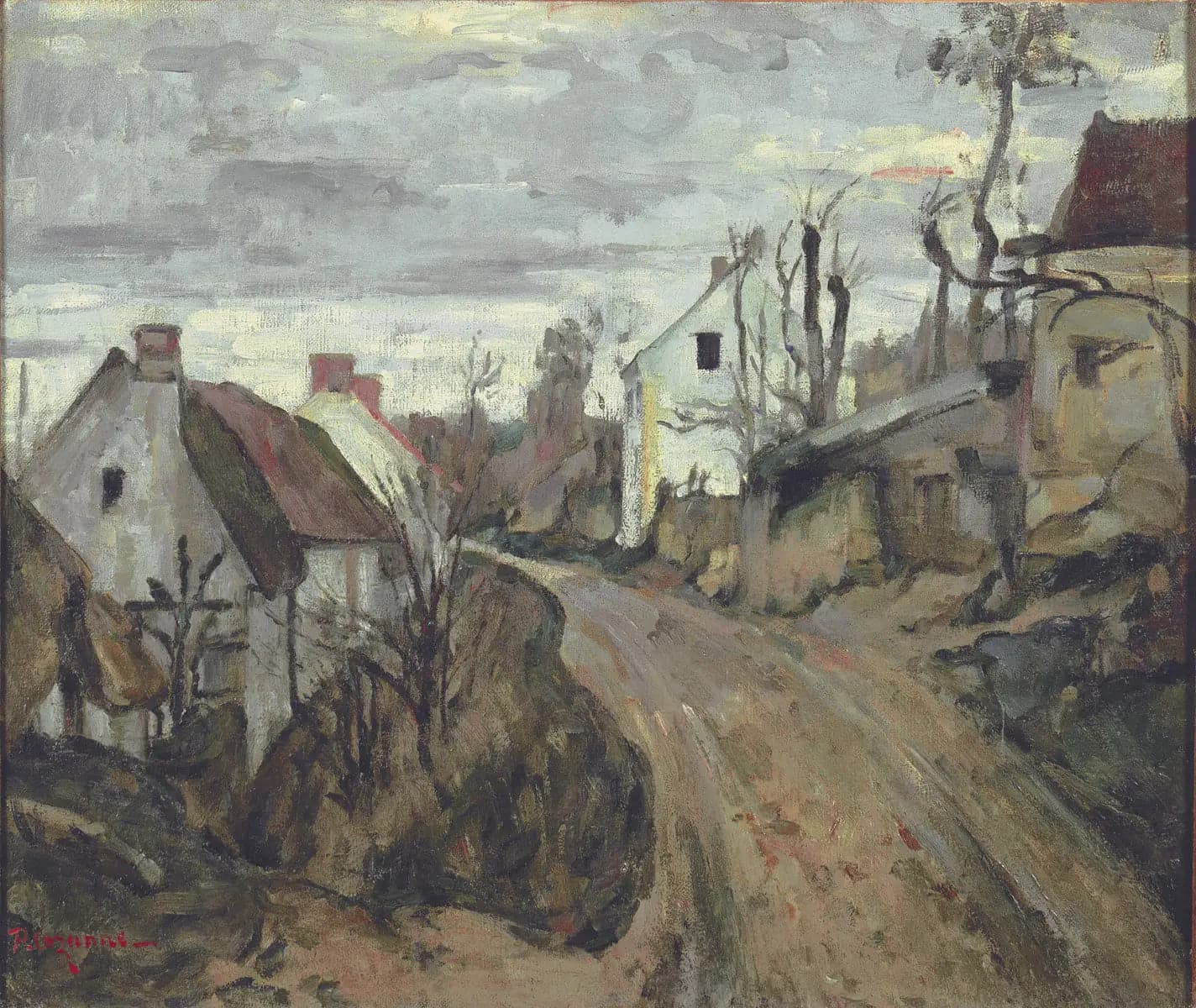
The Old Road at Auvers-sur-Oise
- Original dimensions
- 55.5 x 46 cm
- Museum
- Orsay Museum
- Year
- 1872
Scene depicted
This painting depicts a soothing view of the French countryside, where a winding road seems to invite the viewer to a contemplative stroll. The trees, full of life, stand majestically under a sky that one can almost hear whispering promises of a new day. The composition of a subtle dynamic between shadows and light embodies the deep connection between the artist and the nature he observes.
Historical context
Created in 1872, this painting emblematic of Paul Cézanne was born in the picturesque setting of Auvers-sur-Oise, a village that inspired many artists of the Impressionist movement. At that time, France was in the midst of artistic excitement, marked by new approaches to light and color. Today, the canvas resides at the Orsay Museum , famous for its collection of masterpieces from the 19th century.
Place in the artist's career
The Old Road in Auvers-sur-Oise is one of the significant milestones in Cézanne's career, illustrating his evolution towards a bolder style and a deeper understanding of form and color. At that time, he also created other iconic canvases , such as The Card Players and Mont Sainte-Victoire, marking a period of artistic maturity where color becomes flesh-like and the brushstroke more free.
Anecdote
“Nature cannot be tamed; one must linger to understand it.” These words resonate as an echo of Cézanne's inspiration when he walked along this old road on a spring morning. The timid light illuminated the fields of wildflowers, infusing his painting with a natural essence and granting it an unforgettable emotional depth.
Major exhibitions
From Corot to Modern Art. Memories and Variations