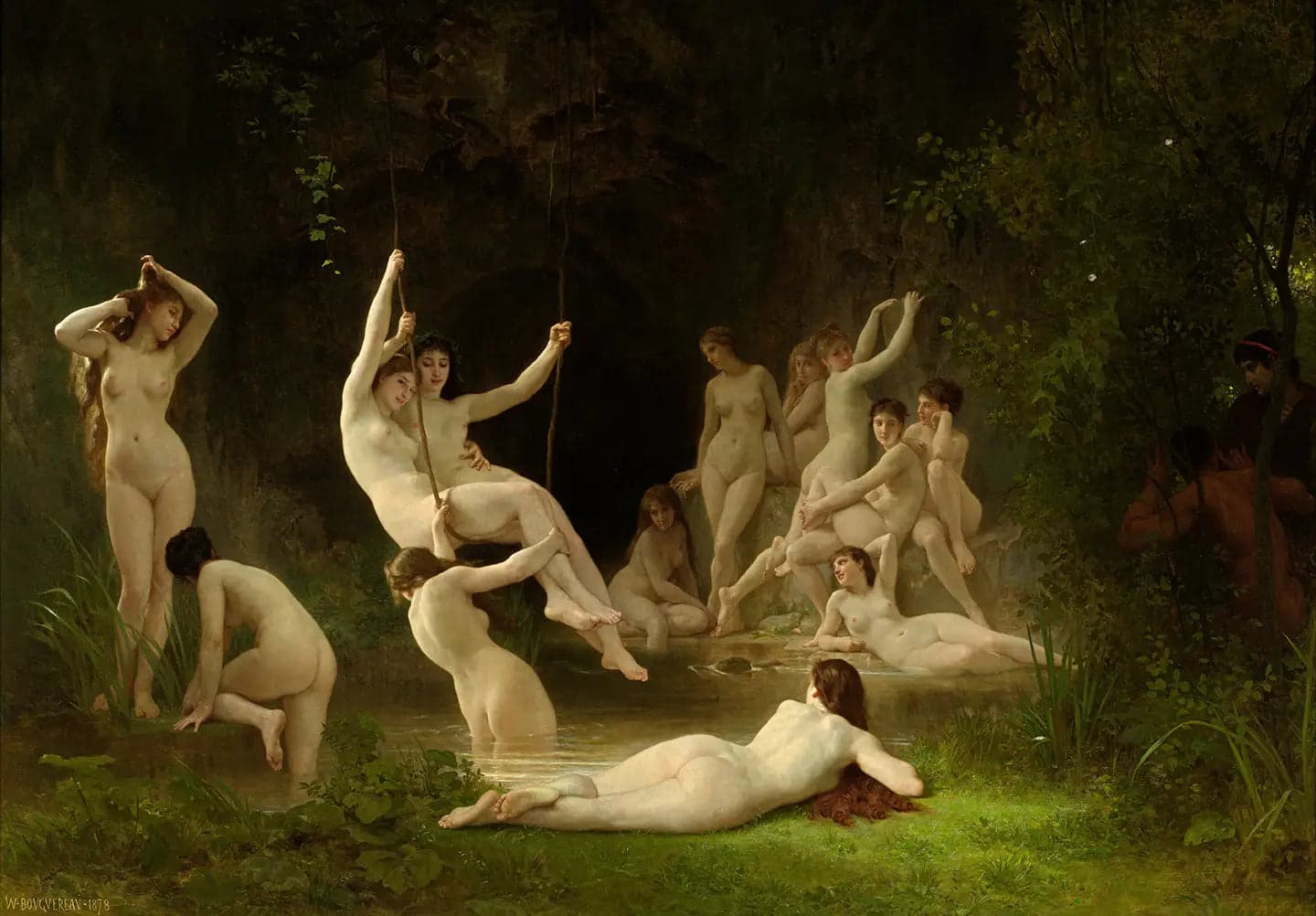
The Nymphaeum
- Original dimensions
- 82.5 x 57 cm
- Movement
- academicism
- Museum
- Haggin Museum
- Year
- 1878
Scene depicted
In Le Nymphée, Bouguereau illustrates a scene filled with mystery and beauty, where nymphets gather around a sparkling water source, their delicate and ethereal forms floating like a sweet memory in the cool air. The composition revisits themes of mythology and nature, thus marrying the human and the spiritual in a disturbing harmony. The figures, dressed in flowing drapery that seems to capture the light from the outside world, draw us into an almost unreal universe where time stands still.
Historical context
Created in 1878, during a period when the academic movement reigns supreme, Le Nymphée by Bouguereau is set in a rich artistic context at the crossroads of traditional aesthetics and modernist advancements. This masterpiece is currently exhibited at the Haggin Museum, an art gem located in Stockton, California. Its dimensions, 82.5 cm by 57 cm, frame a canvas where light and shadow engage in an eternal dance.
Place in the artist's career
Le Nymphée represents a pinnacle in Bouguereau's career, showcasing his unparalleled mastery of realism and the representation of human beauty. Compared to works such as Le Joueux (1879) and La Vierge et l’Enfant (1881), Le Nymphée stands out for its deep exploration of feminine emotions, capturing femininity with such sensitivity that the canvas becomes a visual poem for eternal admiration.
Anecdote
“Every painting I create is a journey into the heart of pure emotion,” Bouguereau might have declared in a poetic outburst, inspired by a sunny morning, where light filtered through the leaves, casting delicate shadows. It is in this enchanting setting that he conceived Le Nymphée, a striking pictorial work, where each character evokes the serenity of a moment suspended in time.