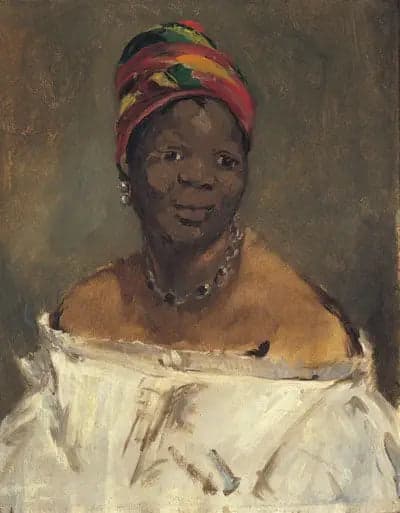
The Negress
- Original dimensions
- 50 x 61 cm
- Museum
- Agnelli Pinacoteca
- Year
- 1862
Scene depicted
“The Negress” immerses us in a delicate scene, where the black woman is portrayed with rare grace and dignity. This sublime painting, far from clichés, depicts the woman as a symbol of strength and beauty. Manet succeeds in combining an imposing silhouette with a serene atmosphere, thus revealing the depth of the human soul through his art.
Historical context
Created in 1862, during a time when artistic conventions were being questioned, the painting “The Negress” is deeply rooted in the Impressionist movement that was emerging in Paris. Édouard Manet , an iconic figure of modernity, managed to capture a precious moment of Parisian life. This canvas is currently displayed at the Agnelli Pinacoteca, where it continues to move visitors with its evocative power.
Place in the artist's career
Positioning the canvas “The Negress” in Manet's career, we have here a significant work, foreshadowing his deeper reflections on society and human representation. Alongside “Luncheon on the Grass” and “Olympia,” this painting constitutes an essential milestone in his evolution, demonstrating his growing mastery of colors and emotions.
Anecdote
“Art is a piece of reality, but captured in its purity.” In this thought, Manet evoked the very essence of his masterpiece . One sunny morning in Paris, he encounters, in the tumult of the street, the vibrant gaze of a woman, inspiring the artist to create this painting that will capture her essence and amplify the voice of beauty in the world of art.