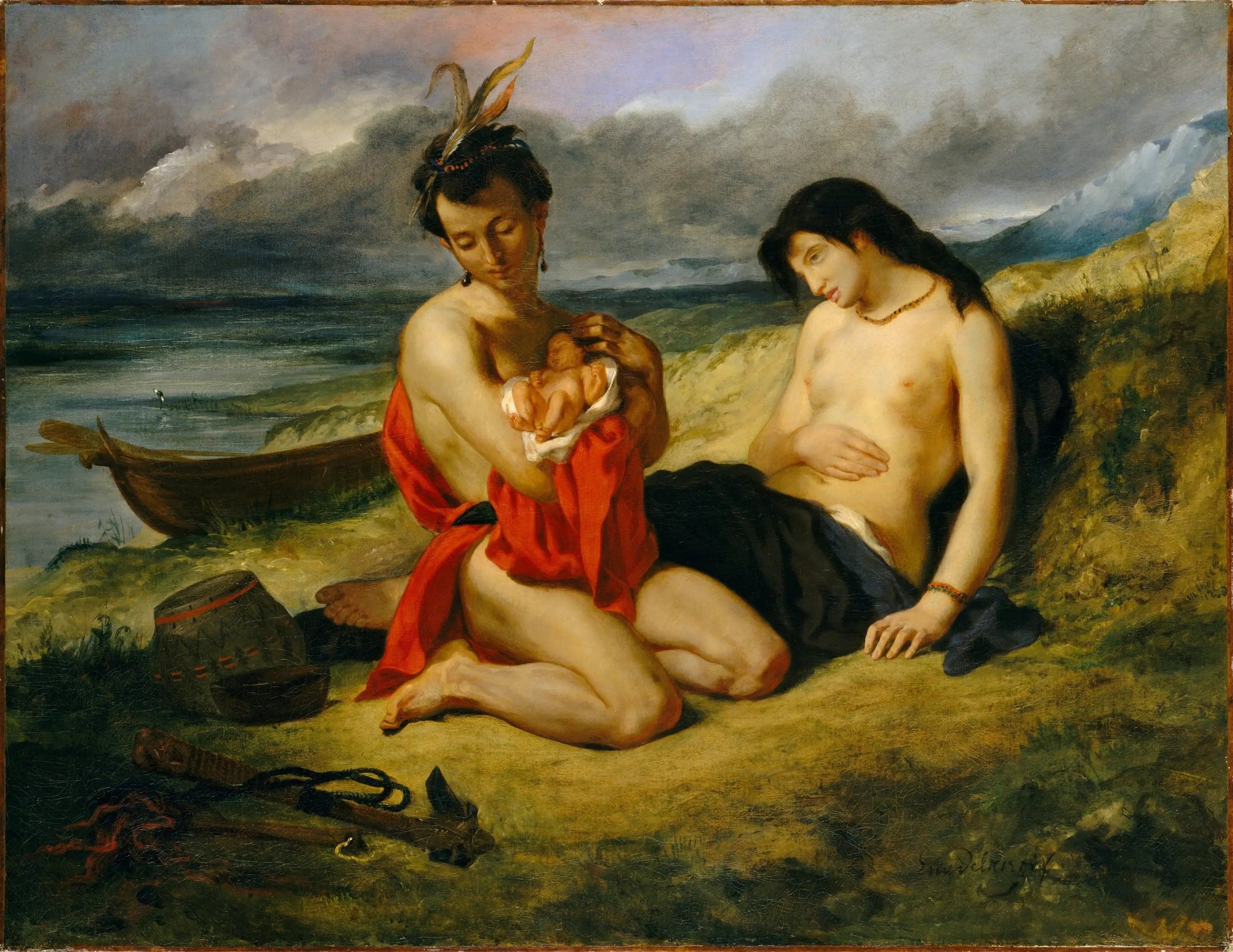
The Natchez
- Original dimensions
- 116.8 x 90.2 cm
- Movement
- academicism
- Museum
- Metropolitan Museum of Art
- Year
- 1835
Scene depicted
This painting depicts a poignant scene of emotion and drama, illustrating the tragic encounter between the Natchez, a Native American tribe, and the expanding colonial world. In a masterful composition, Delacroix manages to convey the struggle for survival and the quest for dignity through emblematic figures, each vibrant with a life rooted in a bygone past.
Historical context
Artwork: The Natchez |BRK| Artist: Eugène Delacroix |BRK| Year: 1835 |BRK| Museum: Metropolitan Museum of Art |BRK| Dimensions: 116.8 x 90.2 cm |BRK| Artistic Movement: academicism |BRK|
Place in the artist's career
The Natchez represents a pivotal moment in Delacroix's career, marking both his rise in the art world and the affirmation of his unique style. Compared to other paintings , such as Liberty Leading the People and The Massacre at Chios , one perceives a dramatic evolution in the expression of emotions and the intensity of colors, placing The Natchez in a period of unparalleled artistic maturity.
Anecdote
Delacroix once declared: “Painting is the reflection of the soul.” One morning, while strolling along the banks of the Seine, he felt a sudden inspiration, ignited by the soft light of dawn. Every brushstroke that composes The Natchez is a manifestation of this inspiration, capturing the very essence of the depicted scene.