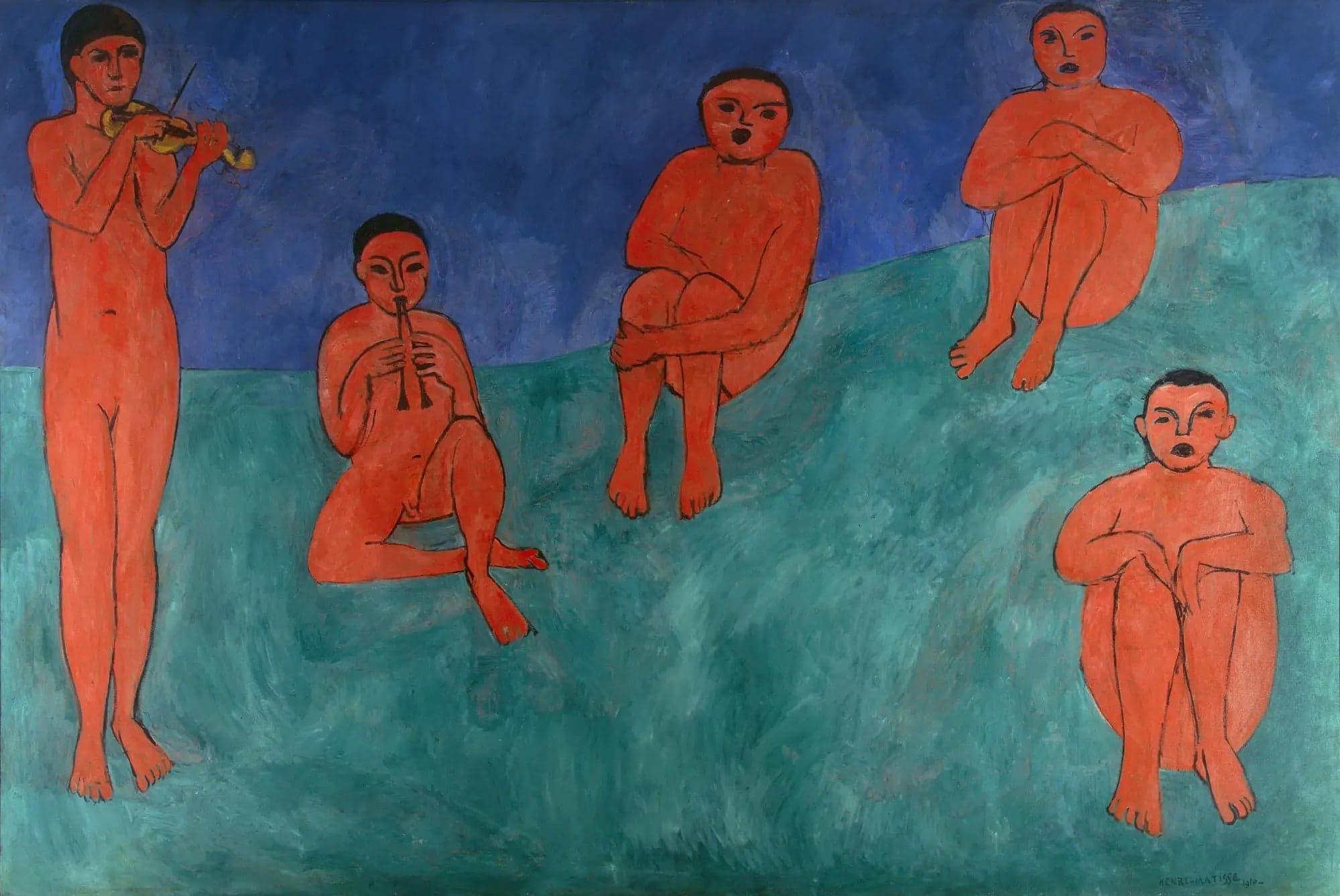
The Music
- Original dimensions
- 389 x 260 cm
- Museum
- Hermitage Museum
- Year
- 1910
Scene depicted
At the heart of Music , a vibrant celebration of human harmonies and art. The composition revolves around dancing figures, symbols of joy and life, immersed in captivating hues. These characters embody a moment of communion, as if the music itself resonated on the canvas, transcending the simple pictorial frame to invite the viewer to feel the raw emotion of the melody.
Historical context
Created in 1910 in France, Music stands as an emblematic work of Fauvism , an inventive artistic movement that champions emotion over realistic representation. At this time, Matisse is already recognized for his chromatic boldness and his constant search for freedom in artistic expression. Currently exhibited at the prestigious Hermitage Museum , this canvas of imposing dimensions — 389 x 260 cm — captivates with its vital momentum, an invitation to appreciate the harmony of sounds and colors.
Place in the artist's career
Music represents a decisive step in Matisse's career, where his style reaches a fascinating maturity. In comparison, his earlier works like The Woman with the Hat and later ones, such as The Dance , illustrate an evolution towards an increasingly assertive abstraction. In this painting, the artist explores the rhythms of color, driven by his desire to go beyond mere representation to touch the very essence of music.
Anecdote
“Music is the echo of the soul,” said Matisse as he settled into his studio amidst the spring scents, his white canvas waiting to be revealed. Inspired by dance and melody, he brought this painting to life by letting his brush vibrate to the rhythm of an imaginary melody that floated in the air, a suspended moment where creativity and nature meet.
Major exhibitions
Autumn Salon of 1910