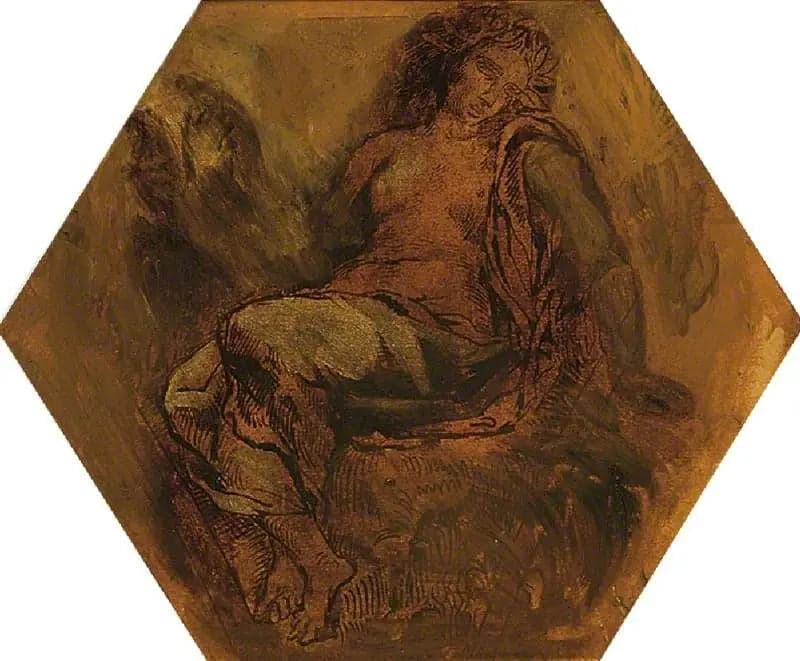
The Muse of Orpheus
- Original dimensions
- 25.4 x 21.2 cm
- Museum
- Fitzwilliam Museum
- Year
- 1846
Scene depicted
This painting invites a poignant encounter between the artist and his muse, Orpheus, an emblematic figure of love and passion. At the heart of this delicate scene, Delacroix explores the power of the arts and music, paying tribute to the transcendent emotion that awakens the senses. The delicate nuances of color and the graceful pose of the muse evoke a dreamlike aspiration towards the divine, highlighting the sacred bond between humanity and artistic inspiration.
Historical context
Artwork: The Muse of Orpheus |BRK| Artist: Eugène Delacroix |BRK| Year: 1846 |BRK| Museum: Fitzwilliam Museum |BRK| Dimensions: 25.4 x 21.2 cm |BRK|
Place in the artist's career
The Muse of Orpheus represents a pivotal moment in Delacroix's career, marking an evolution towards a definitive maturity in his compositions. When compared to other paintings like “ Liberty Leading the People ” and “ The Death of Sardanapalus ”, one observes a technical-emotional refinement with increasingly bold and visually spectacular artistic discourses.
Anecdote
“Creativity is a struggle, but it is also a dance.” Such could be the spirit that inhabited Eugène Delacroix while sketching the painting of his muse. Inspired by the beauty of ancient myths, the artist's creative process likely took shape one intoxicating spring morning, when the ardors of nature merge with the romantic aspirations of the soul.