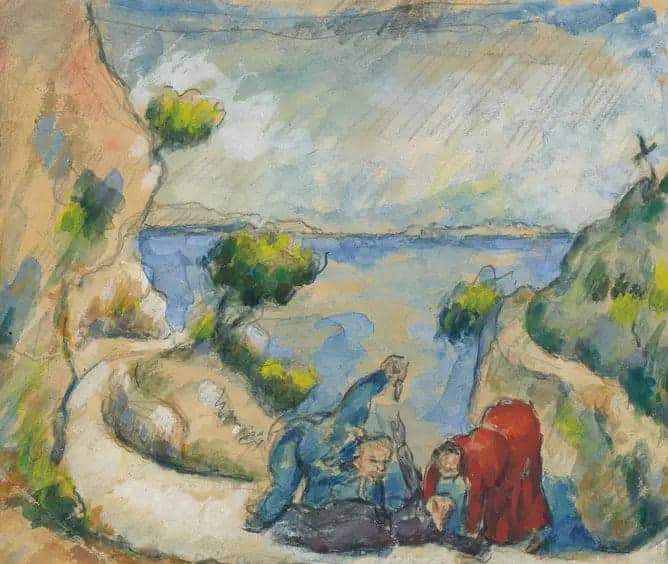
The Murder in the Ravine
- Original dimensions
- 17.5 x 14.6 cm
- Museum
- Not specified
- Year
- 1874
Scene depicted
The painting “The Murder in the Ravine” immerses us in a troubling duality. At the heart of the scene, a brilliant light juxtaposes the drama unfolding among the shadows of a wild nature. This canvas , imbued with an atmosphere that is both tense and contemplative, captures a tragic event while paying homage to the beauty of the surrounding landscape.
Historical context
Created in 1874, this painting emblematic of Paul Cézanne is at the heart of the Impressionist movement that shook France at that time. Celebrating a new artistic vision, Cézanne is set within a rich historical framework, between the exploration of nature and the dawn of modernity. Today, this canvas remains elusive in museums, yet continues to fascinate with its quest for depth and emotion, suspending time through its dimensions of 17.5 x 14.6 cm.
Place in the artist's career
“The Murder in the Ravine” represents a crucial step in the career of Paul Cézanne . This canvas is part of a period of artistic maturation, where the artist seeks to combine Impressionism and structure. In comparison, his works “The Card Players” and “The Montagne Sainte-Victoire” testify to an evolution towards a more geometric composition and a bolder color palette.
Anecdote
“Every brushstroke is a silent conversation with nature.” One spring morning, as light plays among the branches, Cézanne finds inspiration in a mysterious ravine. This quote evokes the deep connection between the artist and his masterpiece , like a whisper that the painting conveys to those who gaze upon it.