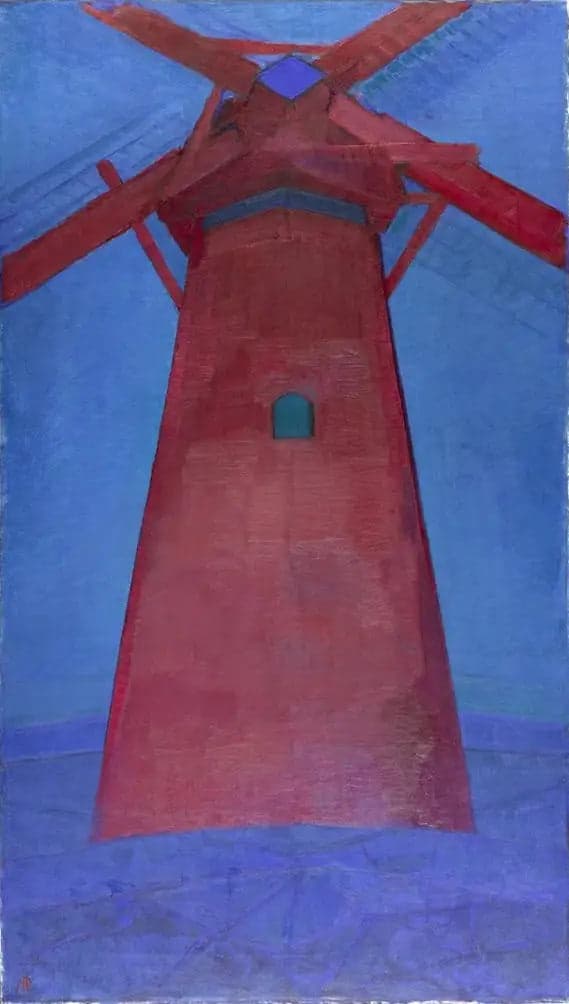
The Moulin Rouge
- Original dimensions
- 86 x 150 cm
- Museum
- The Hague Museum of Art
- Year
- 1910
Scene depicted
In “Le Moulin Rouge - Piet Mondrian ,” the scene unfolds under the shimmering lights of an iconic Parisian cabaret. Artists and spectators intertwine in a bold geometric composition, carried by a dynamic movement that seems to vibrate to the rhythm of the music. Mondrian uses simplified shapes to convey a warm and lively atmosphere, emblematic of a time when the joy of living is at its peak.
Historical context
Year: 1910 |BRK| Museum: The Hague Museum of Art |BRK| Dimensions: 86 x 150 cm
Place in the artist's career
This painting is at the heart of Mondrian's artistic trajectory, marking a turning point towards pure abstraction. Alongside other canvases such as “Composition with Red, Blue and Yellow” and “Broadway Boogie Woogie,” “Le Moulin Rouge” testifies to the artist's stylistic evolution, at a time when he refines a minimalist and universal approach to art.
Anecdote
Piet Mondrian once stated: “Art should not imitate nature, but capture its essence.” This quote resonates strongly with the genesis of this masterpiece , created one spring morning in the shade of an old oak tree, where the artist encountered faces illuminated by the joy of nocturnal living. The emotion that swept through him at that moment finds a powerful echo in the painting that captures all the energy of the famous Parisian cabaret.