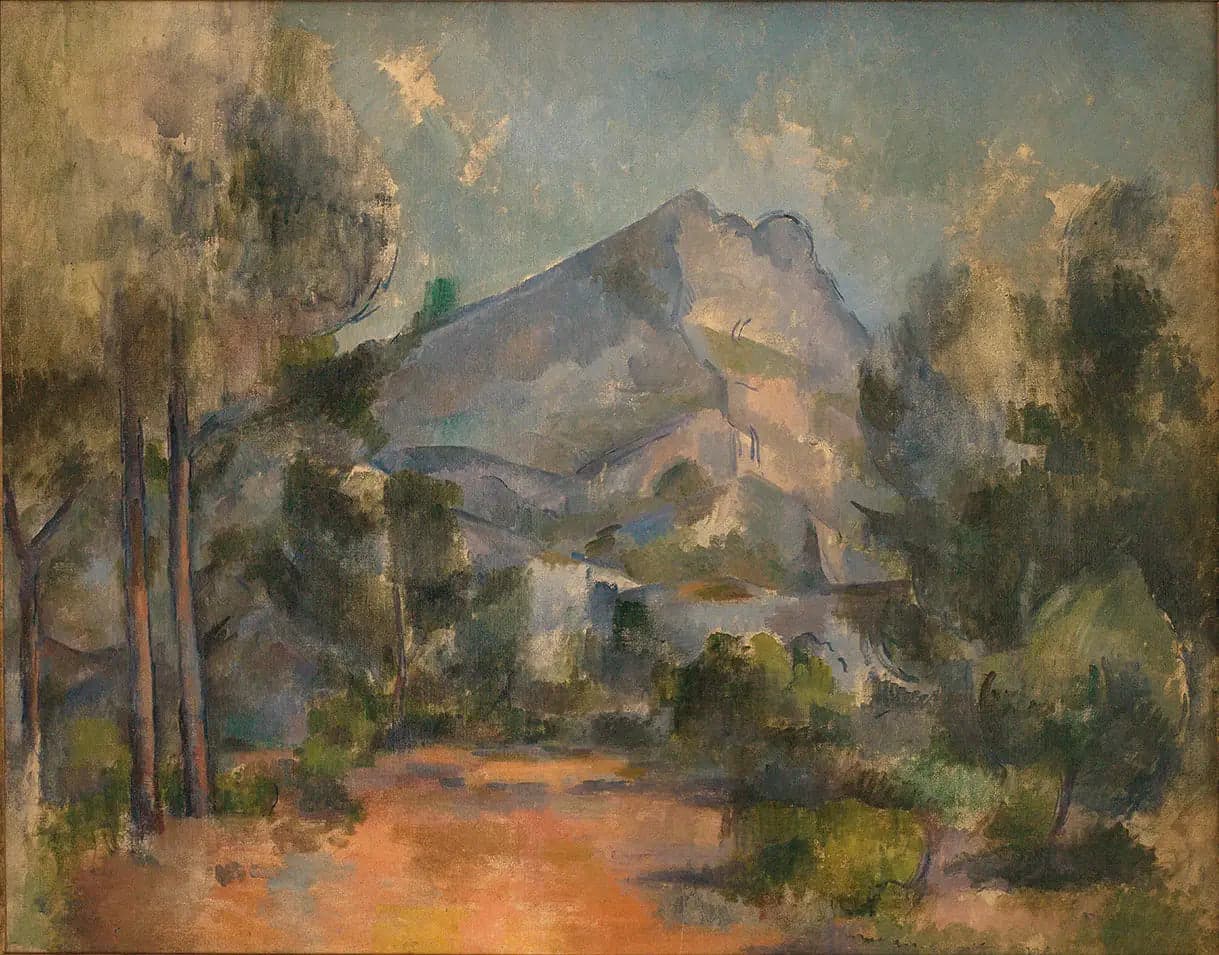
The Montagne Sainte-Victoire
- Original dimensions
- 46 x 55.6 cm
- Museum
- Detroit Institute of Arts
- Year
- 1904
Scene depicted
In this painting, Cézanne invites us to contemplate the famous Mountain Sainte-Victoire, majestic and imposing, surrounded by a Provençal landscape vibrant with colors and textures. The painting depicts not only a geographical scene but also transports the viewer on a visual journey where nature comes to life through a subtle play of light and shadow. Each brushstroke becomes a quest for harmony, a celebration of the soothing rurality of the region.
Historical context
Created in 1904, this painting emblematic finds its roots in the enchanting region of Provence, in France. Paul Cézanne , pioneer of post-impressionism , masterfully captured the majesty of The Mountain Sainte-Victoire, infusing his pictorial work with light and life. This canvas is present at the Detroit Institute of Arts , testifying to a rich cultural heritage and an era when art sought to evoke emotion through color and form. The dimensions of this canvas make it a prime piece, harmoniously fitting into any space.
Place in the artist's career
The Mountain Sainte-Victoire represents a turning point in Cézanne's career, marking a period of maturity where his style solidifies. Alongside The House of Jas de Bouffan and The Card Players , this painting illustrates the evolution of the artist, moving from a naturalistic approach to a more abstract exploration, where each shape and color is carefully orchestrated to create a lively composition.
Anecdote
“Nature is my only master,” said Cézanne, a testament to his commitment to reproducing the beauty of his environment. Imagine him, one spring morning, facing this revered mountain, the air filled with the scent of pines and garrigue flowers, his spirit ignited by the sight of this landscape. It is this emotion that expresses itself so powerfully in The Mountain Sainte-Victoire , a fusion of sensations and colors.