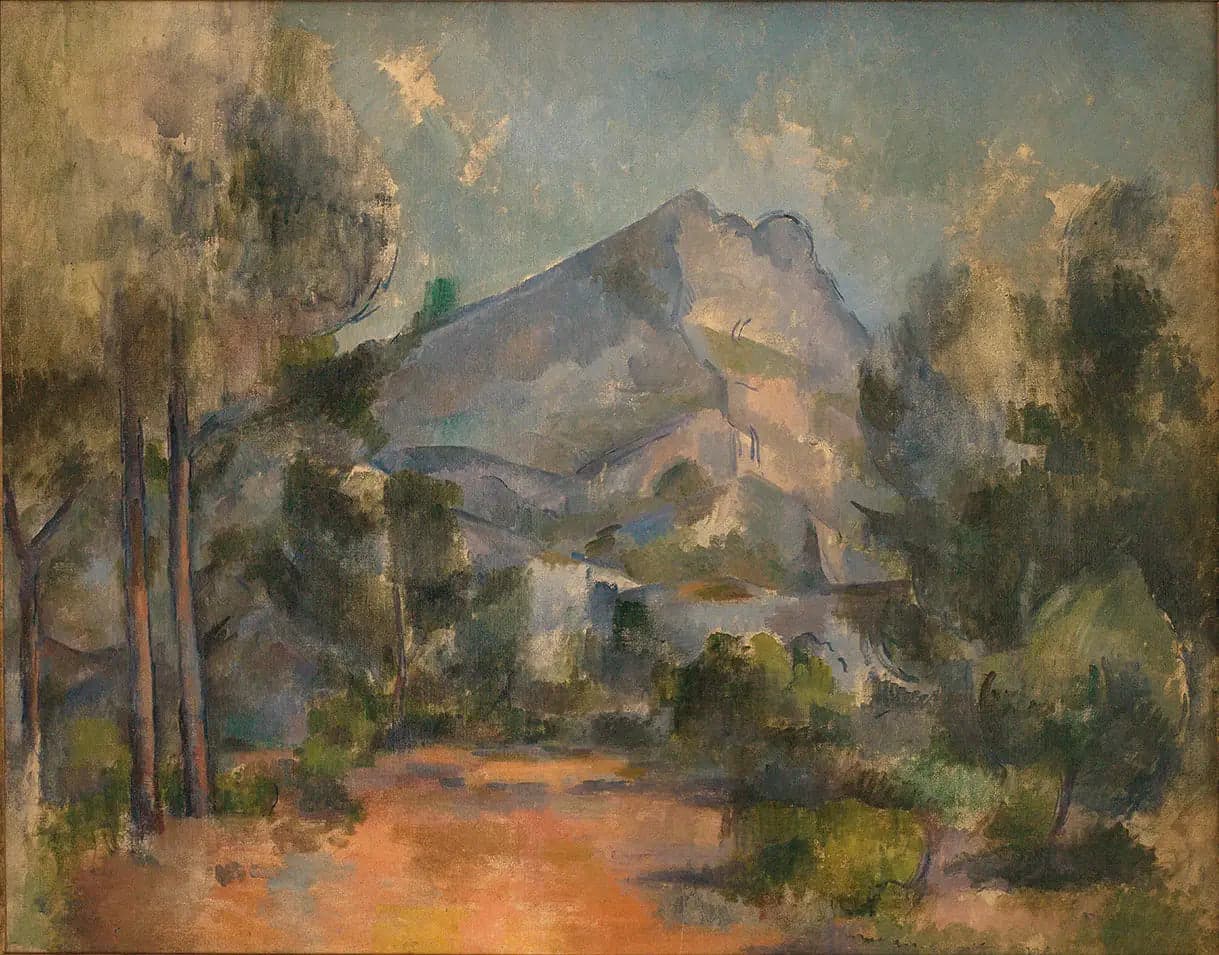
The Montagne Sainte-Victoire
- Original dimensions
- 95.2 x 65 cm
- Museum
- Orsay Museum
- Year
- 1890
Scene depicted
In this painting, Paul Cézanne was able to encapsulate the majesty of The Mountain Sainte-Victoire, revealing through his brushstrokes a depth of field that evokes the vast landscapes of southern France. The geometric shapes of the fields and the vibrant hues of the trees weave a striking visual harmony, embodying the essence of the Provençal landscape with unparalleled sensitivity.
Historical context
Created in 1890, this canvas is emblematic of the beautiful region of Provence, where light and landscapes inspired many artists. Paul Cézanne , a major figure of post-impressionism , offers here a work deeply marked by his exploration of forms and colors, a true bridge between tradition and modernity. Currently exhibited at the Orsay Museum , this painting measures 95.2 x 65 cm, a format that allows one to admire every detail of this vibrant composition.
Place in the artist's career
This painting represents a pivotal period in Cézanne's career, where he begins to detach from impressionist influences, crossing a threshold towards a more mature personal style. In parallel with other works such as “The Large Bathers” and “The House of Jas de Bouffan,” one will observe an admirable evolution of his technique and creative vision.
Anecdote
“Art is a reflection of nature, an interpretation of sensations, an invitation to feel the world.” It was while contemplating The Mountain Sainte-Victoire on a spring morning, as colors mingled with the soft light, that Cézanne captured the very essence of his subject. This inspiration, born from a silent walk, gave life to a masterpiece that has become essential in the history of art.